
Finding the Right Charcoal Grill for Your Backyard
AFFILIATE DISCLOSURE
As an Amazon Associate I earn from qualifying purchases. This article contains affiliate links.
Read our full disclosure.
A great charcoal grill should do more than give your burgers a smoky edge. It should hold a steady fire, make two-zone cooking reasonably simple, clean up without covering your patio in ash, and offer enough room to cook a full meal without crowding the grate.
That balance is harder to find than it sounds. Some grills are wonderfully compact but too small for indirect cooking. Others excel at smoking or high-heat searing but cost considerably more and take up a lot of outdoor space. And while nearly every charcoal grill promises durable construction, the bowl, lid, vents, grate, and ash-management system make a noticeable difference after months of real backyard use.
For this guide, I compared manufacturer specifications, current pricing, expert testing, long-term review consensus, and practical use cases. I looked at how each model handles steady heat, cooking capacity, cleanup, portability, fuel efficiency, and the kinds of meals people actually cook at home—from quick weeknight burgers to slow-smoked ribs.
The Weber Original Kettle Premium 22-Inch is the safest overall choice for most households. Its 363-square-inch cooking area gives you enough room for family meals and two-zone cooking, while the hinged grate, built-in thermometer, One-Touch cleaning system, and enclosed ash catcher make it easier to live with than a bare-bones kettle. Independent testing and review coverage also continue to praise the model for its controllability, sturdy construction, and value.
That said, “best overall” does not mean “best for everyone.” A smaller Weber kettle may make more sense on a compact patio, while the Smokey Joe is better for camping and tailgating. If smoking is your main goal, a Weber Smokey Mountain Cooker offers a more specialized setup. For powerful searing, the Oklahoma Joe’s Rambler brings a heavy-duty build and cast-iron grates, and serious grillers may prefer the heat retention and versatility of a premium kamado.
So, whether you want a dependable backyard workhorse, a portable grill for weekend trips, or a high-end cooker that can smoke, roast, bake, and sear, these seven charcoal grills are the strongest options to consider in 2026.
Quick Picks: The 7 Best Charcoal Grills
Comparison Table
| Category | Product | Main Reason to Buy |
|---|---|---|
| Best overall | Weber Original Kettle Premium 22-Inch | Versatile, affordable, and easy to control |
| Best budget | Weber Original Kettle 18-Inch | Compact and dependable |
| Best portable | Weber Smokey Joe 14-Inch | Lightweight and inexpensive |
| Best kamado | Kamado Joe Classic Joe II | Excellent heat retention and smoking versatility |
| Best for searing | Oklahoma Joe’s Rambler Portable | Heavy-duty build and cast-iron grates |
| Best for smoking | Weber Smokey Mountain Cooker 18-Inch | Designed for low-and-slow barbecue |
| Best premium hybrid | Weber Summit Kamado S6 | Kamado performance with steel construction |
AFFILIATE DISCLOSURE
As an Amazon Associate I earn from qualifying purchases. This article contains affiliate links.
Read our full disclosure.
1. Weber Original Kettle Premium 22-Inch

Best for: Most backyard cooks
The Weber Original Kettle Premium 22-Inch is the charcoal grill I’d recommend first to most people. It has the classic kettle shape, but the design is refined enough to handle far more than weekend burgers. Use it for high-heat searing, indirect cooking, roasting, or the occasional batch of slow-smoked ribs.
With 363 square inches of cooking space, the grill is roomy enough for family meals and can accommodate up to 13 burgers, according to Weber. The porcelain-enameled bowl and lid help retain heat while resisting rust, peeling, and scratches. Weber also includes a hinged grate, built-in thermometer, One-Touch cleaning system, and enclosed ash catcher.
Key Features:
- 22-inch cooking grate.
- 363 square inches of cooking space.
- Porcelain-enameled steel bowl and lid.
- Hinged plated-steel cooking grate.
- Built-in lid thermometer.
- One-Touch cleaning system.
- Enclosed high-capacity ash catcher.
- Two all-weather wheels.
- Ten-year limited warranty on the bowl and lid.
Real-World Impression
The kettle design makes two-zone cooking fairly approachable, even if you’re still learning how to manage charcoal. I like placing the coals on one side of the bowl and leaving the other side cooler. That gives you a hot zone for searing and a gentler area for finishing food with indirect heat.
That setup is especially handy when you’re cooking foods with different timing requirements. Burgers can go directly over the coals, while chicken thighs, ribs, or a whole bird can move to the cooler side once the outside has browned. It also gives you somewhere to move food if a flare-up starts.
The built-in lid thermometer is useful for getting a quick read on the grill’s internal temperature without lifting the lid. However, it measures the air near the top of the cooker, not necessarily the temperature at the cooking grate. For precise smoking or longer cooks, I’d pair it with a separate digital probe thermometer.
The hinged grate is another practical touch. Instead of lifting the entire cooking surface, you can flip up one side to add charcoal or wood chunks while cooking. The enclosed ash catcher also makes cleanup less messy and helps keep loose ash from blowing around the patio. Weber lists the grill as suitable for cooking for six to eight people and includes a 10-year limited warranty on the bowl and lid.
Drawbacks:
- The plated-steel grate is less heat-retentive and durable than cast iron.
- Temperature control takes practice, especially if you are new to charcoal.
- Wind can make it harder to maintain a steady cooking temperature.
- Assembly takes longer than with a small portable grill.
- There is no dedicated warming rack.
Bottom Line
If you want one charcoal grill that can handle everyday burgers, family cookouts, indirect cooking, and occasional smoking, the Weber Original Kettle Premium 22-Inch is the safest choice. It strikes an appealing balance between cooking space, useful features, outdoor durability, and price without requiring the investment or learning curve of a premium kamado grill.
2. Weber Original Kettle 18-Inch

Best for: Small patios and tighter budgets
The Weber Original Kettle 18-Inch is the compact alternative to Weber’s popular 22-inch model. It keeps the familiar kettle design and straightforward charcoal cooking experience but takes up less room, making it a practical pick for apartment patios, small yards, and households that usually cook for two to four people.
With 240 square inches of cooking space, the grill can hold up to nine burgers, according to Weber’s listed specifications. That is enough capacity for most weeknight meals without committing to the larger footprint or higher fuel use of a full-size kettle.
Key Features:
- 18-inch cooking grate.
- 240 square inches of cooking space.
- Porcelain-enameled bowl and lid.
- Built-in lid thermometer.
- Hinged grate on upgraded versions.
- One-Touch cleaning system on premium configurations.
- Two wheels for moving the grill around a patio.
Real-World Impression
The biggest advantage here is the smaller footprint. An 18-inch kettle is easier to position in a compact outdoor area, and it leaves more room for patio furniture, storage bins, or a small prep table. I would especially consider it for an apartment balcony or a narrow backyard where a 22-inch grill may feel oversized.
The smaller bowl also uses less charcoal than the larger model, which is helpful if you grill occasionally or typically prepare a quick dinner rather than an all-day barbecue. It can heat up relatively quickly, making it well suited to weeknight burgers, sausages, chicken pieces, vegetables, and a few steaks.
There is a trade-off, of course: the grate becomes crowded sooner. You can still create a two-zone fire, but the hot and cool areas are smaller. Once you add several pieces of chicken, vegetables, and a cooler indirect section, there may not be much room left for rearranging food. The 18-inch model is best when you cook modest portions and do not need to manage several dishes at once.
The built-in lid thermometer provides a useful temperature reference, while the porcelain-enameled bowl and lid help the grill retain heat and stand up to outdoor exposure. On upgraded versions, a hinged cooking grate makes it easier to add charcoal without removing the entire grate.
Drawbacks:
- Less room for a full two-zone setup.
- Large roasts and whole chickens can be difficult to position.
- Limited space for holding cooked food while other items finish.
- Basic versions may not include the Premium model’s enclosed ash catcher.
- Smaller cooking surface is less suitable for entertaining.
Bottom Line
The Weber Original Kettle 18-Inch is a sensible choice for smaller households, compact patios, and occasional grillers who want a dependable charcoal grill without paying for more capacity than they need. It is easier to place, uses less charcoal, and handles everyday meals well.
If you regularly cook for more than four people, host backyard gatherings, or want plenty of room for indirect cooking, I would step up to the 22-inch Weber Original Kettle Premium instead. The extra cooking space makes a noticeable difference once you start using two-zone fires or preparing larger cuts of meat.
3. Weber Smokey Joe 14-Inch

Best for: Camping, balconies, and tailgating
The Weber Smokey Joe 14-Inch is the most portable grill in this lineup. It brings the familiar kettle design to campsites, tailgates, beach picnics, and compact patios without requiring a grill cart or a permanent outdoor setup.
Its 147-square-inch cooking surface can hold up to six burgers, according to Weber. The compact grill measures 17 inches high, 14.2 inches wide, and 16.5 inches deep with the lid closed, so it is relatively easy to carry, store, and fit into a vehicle.
Key Features:
- 14-inch cooking grate.
- 147 square inches of cooking space.
- Rust-resistant plated-steel cooking grate.
- Rust-resistant aluminum dampers.
- Compact, lightweight portable design.
- Tuck-N-Carry lid lock on the current model and Premium versions.
- Porcelain-enameled bowl and lid.
- Ash catcher to help protect surfaces and simplify cleanup.
- Ten-year limited warranty on the bowl and lid.
Real-World Impression
The Smokey Joe makes the most sense when the grill needs to travel. It is small enough for a campsite, beach cookout, tailgate, picnic, or balcony, and the lid lock helps keep the bowl and lid together during transport. Weber also says the lid lock can function as a lid holder while you cook, which is a handy detail when tabletop space is limited.
Because the cooking surface is small, the grill uses a modest amount of charcoal. That is useful for quick meals where you do not want to light a full-size kettle. It works particularly well for sausages, grilled vegetables, a few chicken pieces, or a small batch of burgers.
I also like the Smokey Joe as a secondary grill. You can use a larger kettle for the main meal and keep this one nearby for vegetables, appetizers, or foods that need a different cooking temperature. It is a simple way to add extra cooking capacity without buying another full-size grill.
The compact size is both its strength and its limitation. You can create a small two-zone setup, but the cooking zones will be narrow. The standard model also does not include a built-in thermometer, so temperature management depends more on airflow, charcoal placement, and cooking experience.
Drawbacks:
- Standard model does not include a built-in thermometer.
- Limited space for two-zone cooking.
- Low cooking height may be uncomfortable for longer cooking sessions.
- Ash cleanup is less convenient than on a full-size kettle, despite the included ash catcher.
- Small grate is not suitable for large meals or entertaining.
- Not the best choice for extended smoking sessions.
Bottom Line
The Weber Smokey Joe 14-Inch is a strong choice when portability matters more than capacity. It is inexpensive to operate, easy to transport, and well suited to occasional small meals outdoors.
I would not choose it as my primary backyard grill unless I usually cook for only one or two people. For regular family meals, larger cuts of meat, or reliable two-zone cooking, a full-size 18- or 22-inch kettle will be much more comfortable.
4. Kamado Joe Classic Joe II

Best for: Serious grillers who also smoke
The Kamado Joe Classic Joe II is the premium ceramic kamado pick for cooks who want one outdoor cooker to handle nearly everything. It works as a high-heat grill, a low-and-slow smoker, and—when you add the right accessories—a capable oven for bread and pizza.
Its 18-inch cooking surface provides enough room for family meals, while the thick ceramic body helps retain heat and moisture more efficiently than a typical thin-walled kettle. The grill also includes Kamado Joe’s Divide & Conquer Flexible Cooking System, which separates the cooking surface into multiple levels and zones.
Key Features:
- 18-inch cooking surface.
- Approximately 250 square inches of cooking space with the included grates.
- Thick ceramic insulated body.
- Two-tier Divide & Conquer Flexible Cooking System.
- Air Lift hinge for easier dome lifting.
- Kontrol Tower top vent for airflow adjustment.
- High-temperature grilling capability.
- Low-temperature smoking capability.
- Cart and locking wheels on cart-equipped configurations.
- Fold-down side shelves on included configurations.
- Designed for lump charcoal.
Real-World Impression
The ceramic body is the star of the show. Once the Classic Joe II reaches temperature, it holds heat efficiently and can maintain a steady cooking environment with relatively little charcoal. That makes it particularly appealing for long cooks where constantly adding fuel would be frustrating.
I would use it for brisket, pork shoulder, ribs, and other low-and-slow barbecue, but its range does not stop there. With the vents opened up, it can reach the intense heat needed for steaks. Add the right setup and it can also handle bread, pizza, roasted vegetables, and other foods that benefit from an enclosed, heat-retaining cooking chamber.
The Divide & Conquer system is more useful than a standard flat grate. Its split sections can sit at different heights, allowing you to sear food closer to the fire on one side while cooking or warming something more gently on the other. You can also combine direct and indirect heat in the same cook, which is helpful when preparing steaks, vegetables, or chicken with different cooking requirements.
The Air Lift hinge makes the heavy ceramic dome easier to raise and lower. It does not make the grill lightweight—the complete cooker is still a substantial piece of outdoor equipment—but it makes the lid feel much less cumbersome during everyday use.
Customer feedback is also strong. The Classic Joe II listing at Lowe’s shows a 4.8-out-of-5 rating from 825 reviews, with 99% of reviewers recommending it. A stand-alone configuration is listed at 4.9 out of 5 from 773 reviews, also with 99% recommending it.
Drawbacks:
- Heavy and difficult to move once assembled.
- Costs considerably more than a standard kettle grill.
- Ceramic can crack if dropped, struck, or mishandled.
- Sudden temperature changes may cause thermal shock.
- Accessories and replacement parts can increase the total ownership cost.
- Cooking area is smaller than that of many large barrel-style grills.
- Reaching and maintaining low smoking temperatures takes practice.
Bottom Line
The Kamado Joe Classic Joe II is a strong choice for serious grillers who want one premium cooker for grilling, smoking, baking, roasting, and high-heat searing. Its heat retention and flexible split-grate design offer capabilities a basic kettle cannot match.
Just make sure you have a stable location for it before buying. This is not the grill I would casually move around a small patio, but it is an excellent long-term centerpiece for a dedicated outdoor cooking area.
5. Oklahoma Joe’s Rambler Portable Charcoal Grill

Best for: Portable searing
The Oklahoma Joe’s Rambler is a heavier-duty alternative to lightweight portable kettles. It is still compact enough for a patio, camping setup, or tailgate, but its steel body and thick cast-iron grates give it a more substantial, backyard-grill feel.
The Rambler provides 218 square inches of cooking space—enough for up to six burgers, six steaks, or 12 bratwursts. Oklahoma Joe’s currently lists the Rambler Portable Tabletop Charcoal Grill at an original price of $229.99.
Key Features:
- Portable tabletop design.
- Heavy-duty steel construction.
- Thick cast-iron cooking grates.
- 218 square inches of cooking space.
- Height-adjustable charcoal tray.
- Compact footprint.
- Lid-mounted temperature gauge.
- Adjustable air dampers.
- Removable ash pan.
- Strong heat retention for searing.
- Suitable for patios, camping setups, and tailgating.
Real-World Impression
The Rambler is better suited to serious searing than most lightweight portable grills. Its cast-iron grates retain heat well after preheating, so steaks and burgers get more than a quick kiss of flame—they get a properly hot cooking surface and pronounced grill marks.
The adjustable charcoal tray is another useful feature. You can raise the coals closer to the grate for high-heat searing or lower them when you want gentler cooking. That extra control gives the Rambler more range than its compact size suggests.
The 218-square-inch grate is enough for a small family meal, but this is still a tabletop grill. It is a good size for a few steaks, burgers, sausages, or vegetables—not a large backyard gathering. Compared with the Weber Smokey Joe, the Rambler feels sturdier and more capable, but it is also considerably heavier and less convenient to carry.
I would place it on a sturdy, level, heat-safe table or stand with plenty of clearance around the sides. Do not set it directly on plastic, wood, dry grass, or another flammable surface, and check the rules wherever you plan to use it.
Customer feedback is generally positive: the Rambler holds a 4.7-out-of-5 rating from 161 Lowe’s reviews, although some owners mention issues involving replacement parts, grates, hinges, or the charcoal tray.
Drawbacks:
- Heavier than typical portable charcoal grills.
- Requires a sturdy table or stand.
- Cast-iron grates need cleaning, drying, and occasional seasoning.
- Cooking area remains limited for large groups.
- More expensive than basic portable models.
- Some owner reviews report concerns about replacement parts, grates, hinges, or warped charcoal trays.
Bottom Line
The Oklahoma Joe’s Rambler is a strong pick for shoppers who want portable charcoal cooking with better searing power and a more durable feel than a lightweight kettle can provide. The cast-iron grates and adjustable charcoal tray make it especially appealing for steaks, burgers, and other foods that benefit from intense, direct heat.
Choose the Rambler if you are comfortable carrying a heavier grill and using a safe tabletop setup. If minimum weight and easy transport matter more than searing performance, the Weber Smokey Joe is the more convenient portable option.
6. Weber Smokey Mountain Cooker 18-Inch

Best for: Dedicated barbecue smoking
The Weber Smokey Mountain Cooker 18-Inch is primarily a vertical charcoal smoker, not an everyday grill. It is designed for low-and-slow barbecue, with enough room for ribs, pork shoulder, brisket, poultry, and other foods that benefit from hours of gentle heat and wood smoke.
Its bullet-style design includes two cooking grates, giving you 481 square inches of total cooking space across multiple levels. That lets you smoke several foods at once while keeping the overall footprint relatively compact.
Key Features:
- Vertical bullet-smoker design.
- Two 18-inch cooking grates.
- 481 square inches of total cooking space.
- Charcoal fuel system.
- Compatible with wood chunks or wood chips.
- Built-in lid thermometer.
- Adjustable airflow vents.
- Separate water pan.
- Porcelain-enameled steel body.
- Side access door for adding fuel, wood, or water.
- Grommet for inserting a digital thermometer probe.
Real-World Impression
The vertical layout is the first thing you notice. Instead of spreading food across a wide kettle or offset smoker, the Smokey Mountain stacks the charcoal, water pan, and cooking grates in a relatively narrow column. That saves patio space while still giving you enough capacity for multiple racks of ribs, pork shoulders, chickens, or other barbecue staples.
This design is especially useful for authentic smoked barbecue because the charcoal sits below the water pan, while the food cooks gradually on the grates above. Add wood chunks or chips to the fire for smoke flavor, adjust the vents to control airflow, and let the cooker work through a long session.
Compared with a kettle grill, the Smokey Mountain is better suited to extended smoking sessions. Its tall chamber and water-pan design make it easier to dedicate the cooker to brisket, ribs, pork shoulder, or poultry for several hours. It is much less convenient for quick burgers, however, and it does not provide a broad direct-grilling surface for high-heat searing.
The water pan acts as a thermal buffer between the charcoal and the food. It helps moderate temperature swings and adds moisture to the cooking environment, which is useful during long cooks. It does not eliminate the need to manage the vents, but it can make the smoker more forgiving as you learn how charcoal airflow affects temperature.
One note: the built-in lid thermometer is best treated as a general reference. Because it sits above the food, it may not match the actual temperature at grate level. For brisket and other long cooks, I would use a digital probe placed near the cooking grate.
Drawbacks:
- Less versatile for everyday grilling.
- Requires longer preheating and cooking times.
- Temperature management takes practice.
- No large direct-grilling surface.
- Vertical layout can make food access less convenient.
- A full rack of ribs may require careful positioning on the 18-inch grates.
- Built-in lid thermometer may not reflect grate-level temperature accurately.
- The smoker is relatively compact, but it is still tall and needs a stable outdoor location.
Bottom Line
The Weber Smokey Mountain Cooker 18-Inch is the right choice when low-and-slow barbecue is your main priority. It delivers authentic charcoal-and-wood smoke, makes efficient use of patio space, and provides two cooking levels for larger smoking sessions.
I would choose it over a kettle if you regularly make ribs, pulled pork, brisket, or smoked poultry. If you mostly want burgers, steaks, vegetables, and quick weeknight meals, a Weber kettle will be more versatile and easier to use.
7. Weber Summit Kamado S6

Best for: Premium performance without a ceramic body
The Weber Summit Kamado S6 is the premium hybrid pick for experienced charcoal cooks who want kamado-style heat retention without a traditional ceramic shell. It combines an insulated dual-wall steel bowl and lid with a large cart-based design, adjustable charcoal positioning, and multiple cooking configurations.
Instead of thick ceramic, Weber uses insulated steel to create a heat-retaining cooking chamber that is faster to heat and less vulnerable to cracking if the grill is bumped. The S6 offers 452 square inches of cooking space, a gas-assisted charcoal ignition system, and controls designed to move between high-heat grilling and low-and-slow smoking.
This is not a compact kamado for a small balcony. It is a substantial outdoor cooking center intended for dedicated grillers who have the patio space and cook often enough to justify a premium investment.
Key Features:
- Insulated dual-wall steel kamado-style construction.
- 452 square inches of cooking space.
- 24-inch cooking area.
- High-heat grilling capability.
- Low-temperature smoking capability.
- Gas-assisted charcoal ignition.
- Adjustable charcoal grate.
- RapidFire lid damper.
- Integrated cart with locking wheels.
- Large stainless-steel work surface.
- Built-in storage area.
- Hinged stainless-steel cooking grates.
- Adjustable airflow controls.
- More impact-resistant than traditional ceramic kamados.
- Ten-year warranty on the bowl and lid.
Real-World Impression
The Summit Kamado S6 is designed to replace several outdoor cooking appliances. It can sear steaks over intense heat, grill chicken and vegetables for a family dinner, roast large cuts of meat, or settle into a low-and-slow cook for ribs, pork shoulder, brisket, and other smoked foods.
The 452-square-inch cooking surface is a major advantage. It offers considerably more working room than many 18-inch ceramic kamados, so you can cook for a crowd without stacking everything into a small recessed grate. The adjustable charcoal grate also gives you more control over the relationship between the fire and the food, which is helpful when switching from direct grilling to indirect smoking.
The steel construction is the defining feature. Traditional ceramic kamados are excellent at holding heat, but they are heavy, slow to change temperature, and vulnerable to cracks from impact or thermal shock. The Summit’s insulated steel body aims to retain heat while responding more quickly when you adjust the airflow or charcoal position.
In practical terms, that makes the S6 easier to use for an active household. You still need a permanent or semi-permanent outdoor location—the grill weighs about 238 pounds—but the steel body is less fragile if the cart gets bumped or the equipment is rearranged on the patio. A gas ignition system also reduces the setup time when you want charcoal flavor on a weeknight instead of turning dinner into a lengthy project.
The large cart and integrated work area add to the everyday convenience. There is room to place trays, tools, and ingredients beside the cooking surface, while the storage area helps keep charcoal and accessories nearby.
Drawbacks:
- Very expensive compared with standard kettle grills.
- Requires considerably more patio space.
- Heavy despite being made from steel.
- Accessories can add significantly to the total cost.
- More grill than casual cooks need.
- Premium airflow and charcoal controls require a learning curve.
- Gas ignition requires a compatible disposable fuel cylinder.
- Not portable in the same sense as a tabletop or camping grill.
Bottom Line
The Weber Summit Kamado S6 is a premium grill-and-smoker centerpiece for experienced charcoal cooks who want broad cooking capacity, strong heat retention, and more convenient everyday operation than a traditional ceramic kamado provides.
I would recommend it to someone who grills and smokes frequently, has a dedicated outdoor cooking area, and wants one cooker capable of handling steaks, ribs, roasts, brisket, and family-size meals. For casual cooks or smaller patios, the price, footprint, and complexity are difficult to justify; a Weber kettle or smaller kamado will deliver better value.
What to Look for in a Charcoal Grill
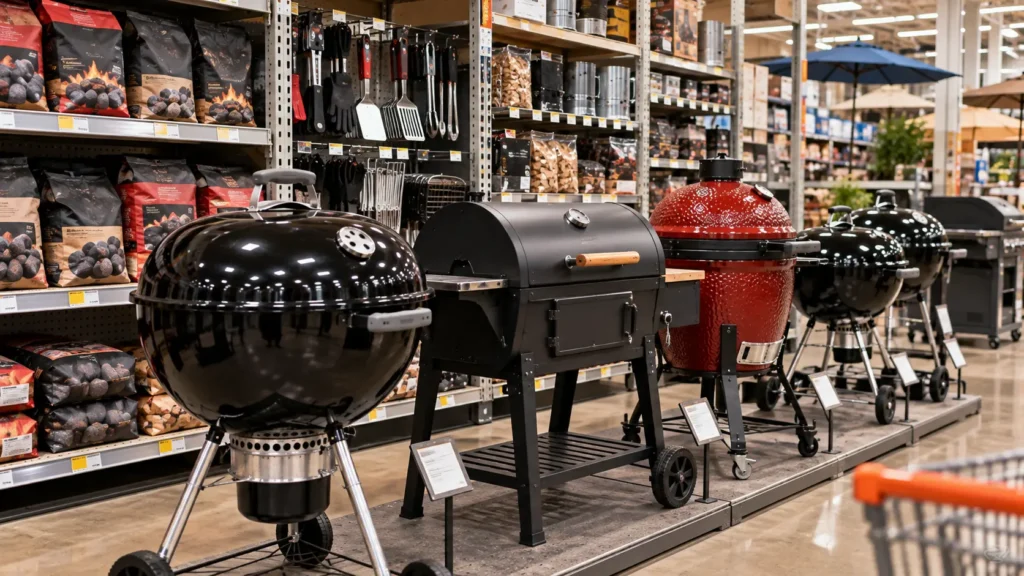
Choosing a charcoal grill is not just about finding the biggest cooking grate or the lowest price. The right model should match how you actually cook, how much outdoor space you have, and how much maintenance you are willing to handle.
Before buying, I would focus on size, heat control, grate material, ash management, weather protection, and temperature monitoring. Those details have more impact on everyday use than flashy accessories.
Choose the Right Size
When an 18-Inch Grill Makes Sense
An 18-inch grill is a good fit for two to four people, especially if you usually cook simple meals such as burgers, sausages, chicken pieces, vegetables, or a couple of steaks.
This size also makes sense for:
- Apartment patios
- Small yards
- Occasional grillers
- Households with limited storage
- Shoppers who want to use less charcoal
The trade-off is cooking space. An 18-inch grate can feel crowded once you add a cooler indirect zone, several pieces of food, and a place to move cooked items.
Why Choose a 22-Inch Grill?
A 22-inch grill offers more flexibility without becoming enormous. The extra grate area makes it easier to create a genuine two-zone fire, cook larger cuts of meat, or prepare several foods at different temperatures.
I generally prefer a 22-inch model for most families because it gives you room to grow into charcoal cooking. You can use only part of the grate for a quick weeknight meal, then use the full surface when friends come over.
A 22-inch grill is especially useful for:
- Family dinners
- Whole chickens and larger roasts
- Ribs and indirect cooking
- Cooking multiple foods at once
- Small backyard gatherings
When to Consider a Larger Grill or Kamado
Frequent entertainers may want a larger barrel grill, a 24-inch cooker, or a premium kamado. These options offer more capacity and may provide better heat retention for extended smoking sessions.
A kamado is particularly appealing if you want one cooker for grilling, roasting, baking, and smoking. Just remember that larger and ceramic models require more space, cost more, and may be harder to move.
Look for Two-Zone Cooking Capability
Two-zone cooking is one of the most useful techniques in charcoal grilling. You create a direct-heat zone with hot coals underneath the food and an indirect-heat zone without coals directly below it.
This gives you much more control than spreading charcoal evenly across the entire grate.
Direct Heat
Direct heat is best for foods that cook relatively quickly, including:
- Burgers
- Steaks
- Hot dogs
- Sausages
- Thin chicken pieces
- Vegetables
It provides the high temperature needed for browning, searing, and developing grill marks.
Indirect Heat
Indirect heat is better for thicker or slower-cooking foods. Place the food away from the coals, close the lid, and let the surrounding heat cook it more gradually.
This works well for:
- Whole chickens
- Pork roasts
- Ribs
- Thick chicken breasts
- Large steaks
- Baked foods
What Two-Zone Cooking Lets You Do
A two-zone setup helps you:
- Sear burgers and steaks over direct heat.
- Finish thicker meats away from the coals.
- Move food away from flare-ups.
- Keep cooked food warm without burning it.
- Add wood chunks for smoking.
- Cook different foods at different temperatures.
For example, I might sear chicken thighs over the hot side until the skin browns, then move them to the cooler side to finish cooking without scorching the outside.
A hinged grate is also helpful because you can add charcoal or wood chunks without removing the entire cooking grate. Buyer’s guides commonly identify a hinged grate, adjustable vents, and effective ash management as valuable charcoal-grill features.
Consider the Grate Material
The cooking grate affects searing, cleanup, durability, and maintenance. There is no single best material for every shopper.
Plated Steel
Plated-steel grates are common on affordable charcoal grills.
Advantages:
- Heat up quickly.
- Usually cost less.
- Are lighter and easier to handle.
- Work well for everyday grilling.
Limitations:
- May be less durable than cast iron.
- Can lose their protective coating over time.
- May not retain heat as effectively for searing.
- Can rust if left wet or neglected.
Plated steel is perfectly practical for a budget kettle, especially if you clean and dry the grate after cooking.
Cast Iron
Cast-iron grates are popular with shoppers who care about high-heat searing.
Advantages:
- Retain heat well.
- Produce strong sear marks.
- Feel solid and substantial.
- Work well for steaks and burgers.
Limitations:
- Require regular cleaning.
- Need to be dried thoroughly.
- May require occasional seasoning.
- Are heavier than plated-steel grates.
- Can rust if exposed to moisture.
I like cast iron for high-heat cooking, but it is not maintenance-free. If you live in a humid or coastal area, be especially careful about drying and lightly oiling the grate when recommended by the manufacturer.
Stainless Steel
Stainless-steel grates are a good choice for shoppers who want durability and easier maintenance.
Advantages:
- Durable.
- Resistant to rust.
- Easier to scrub and maintain.
- Less demanding than cast iron.
Limitations:
- May cost more.
- Can be less effective at retaining heat than thick cast iron.
- May not produce quite the same searing performance.
Stainless steel is a practical middle ground for frequent grillers who want a grate that can tolerate regular outdoor use without extensive seasoning.
Check Ash Management
Charcoal produces ash every time you cook, and managing it well makes a noticeable difference. An enclosed ash catcher or removable ash pan is much more convenient than allowing ash to collect beneath the fire.
A good ash-management system can:
- Simplify cleanup.
- Prevent ash from blowing around.
- Keep patios, decks, and outdoor furniture cleaner.
- Reduce the chance of ash blocking airflow.
- Make it easier to prepare the grill for the next cook.
Weber’s One-Touch system, for example, sweeps cooled ash into an enclosed, high-capacity catcher with the movement of a lever.
Open ash trays can still work, but they have limitations. Ash is more exposed to wind, removal can be messier, and the tray may need to be handled carefully to avoid spilling fine particles across the patio.
Always wait until the charcoal and ash are completely cool before emptying the catcher. Leftover embers can remain hot longer than expected.
Think About Storage and Weather
Even a well-built charcoal grill benefits from protection. Porcelain-enameled bowls and lids are especially useful because the finish helps resist rust and peeling compared with unfinished steel.
A fitted grill cover can help protect:
- Air vents
- Handles
- Wheels
- Cooking grates
- Thermometer hardware
- Hinges and side shelves
Before covering the grill, make sure it is fully cool and dry. Trapping heat or moisture under a cover can cause its own problems.
If you live in a humid or coastal climate, inspect the vents, grate, fasteners, and ash catcher more often. Salt air and moisture can accelerate corrosion, especially when the grill is left outside year-round.
Do not leave ash sitting inside the bowl. Ash can absorb moisture from the air, and damp ash may contribute to corrosion around the charcoal grate, vents, and lower bowl. Empty the ash once the grill has cooled completely, then keep the interior as dry as possible.
Buy a Thermometer
A built-in lid thermometer is useful, but it should be treated as a general guide rather than a precise measurement of the food’s cooking environment.
The thermometer is usually positioned in the lid, while the food sits lower at grate level. That means the temperature near the lid can differ from the temperature directly above the charcoal or in the cooler cooking zone.
For casual burgers and sausages, the built-in gauge may be enough. For longer or more temperature-sensitive cooks, I recommend a digital probe thermometer.
A probe thermometer is especially helpful for:
- Chicken
- Roasts
- Brisket
- Pork shoulder
- Whole poultry
- Long smoking sessions
Use one probe to monitor the cooking chamber near the food and another to check the internal temperature of the meat when necessary. This gives you a much more accurate picture than relying on the lid thermometer alone.
For me, a dependable thermometer is one of the most worthwhile charcoal-grill accessories. It turns temperature management from guesswork into a repeatable process—particularly when you are learning how to hold a steady fire for several hours.
Final Verdict
Best Overall: Weber Original Kettle Premium 22-Inch
AFFILIATE DISCLOSURE
As an Amazon Associate I earn from qualifying purchases. This article contains affiliate links.
Read our full disclosure.
For most backyard cooks, the Weber Original Kettle Premium 22-Inch is the charcoal grill to buy. It balances the things that matter most in everyday use: generous cooking capacity, reliable direct and indirect heat, straightforward cleanup, broad cooking versatility, and a reasonable price.
The 363-square-inch grate gives you enough room for family meals and two-zone cooking without taking over the patio. You can sear burgers and steaks over hot coals, move chicken or larger cuts to the indirect side, and use the lid for roasting or occasional smoking. The hinged grate makes it easier to add charcoal or wood chunks, while the One-Touch system and enclosed ash catcher reduce the usual mess associated with charcoal cooking.
It is not the fanciest grill in this guide, and temperature control still takes practice. But that is part of its appeal: the Weber gives beginners a manageable way to learn charcoal cooking while offering enough flexibility to remain useful as their skills improve. Its long-standing reputation for controllability, durability, and value also makes it an easier recommendation than a more specialized or expensive cooker.