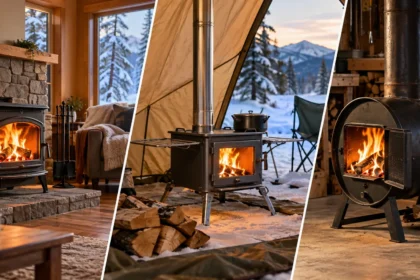

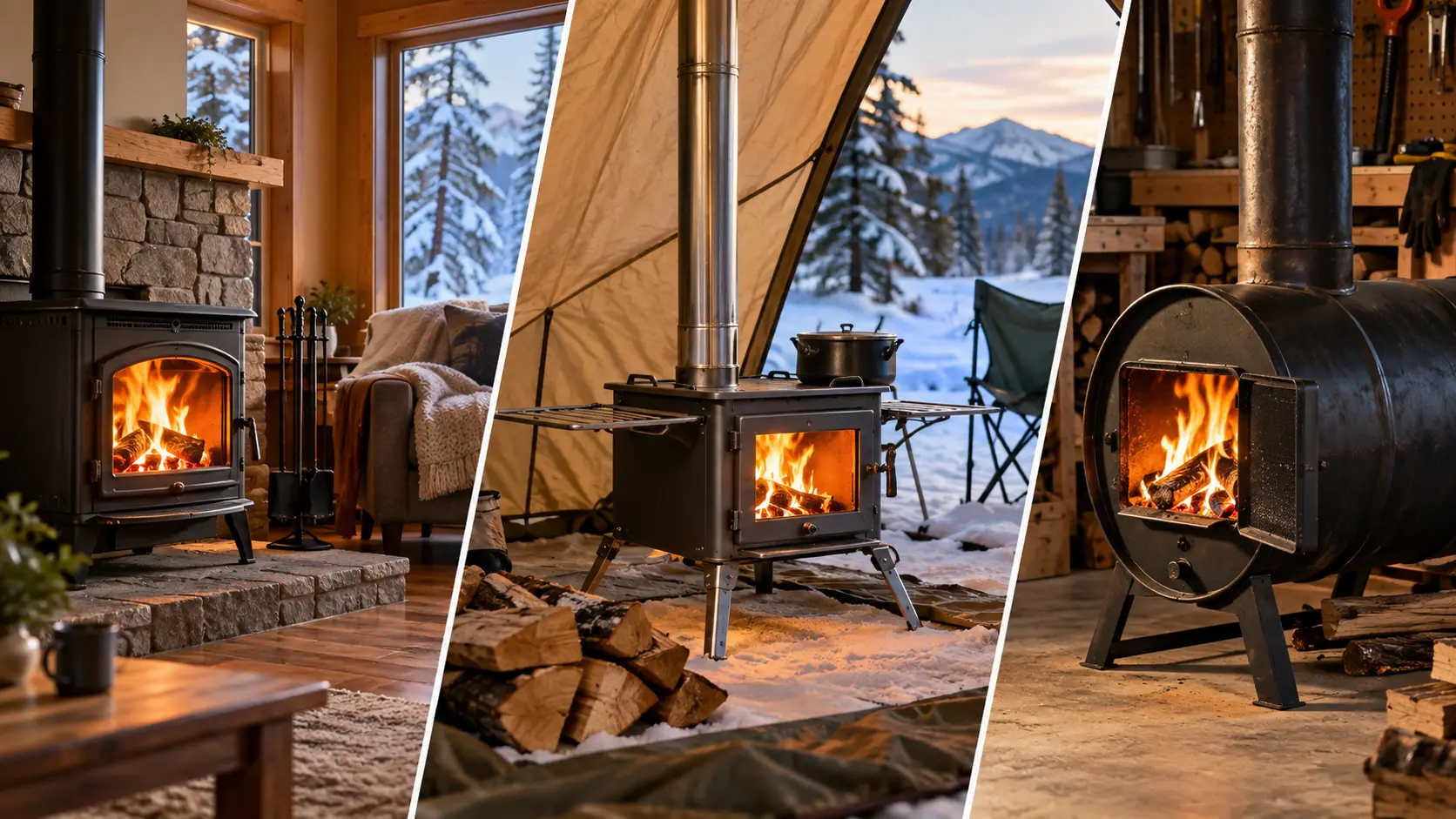
Finding the Right Wood Stove for Every Space
There is something undeniably satisfying about wood heat. Whether you are warming up a small cabin after a rainy afternoon, making coffee in a hot tent before sunrise, adding backup heat to a workshop, or cooking dinner at a hunting camp, the right wood-burning stove can make a cold space feel far more comfortable and useful.
But not every wood stove is built for the same job. A lightweight tent stove may be perfect for a weekend camping trip because it packs into a vehicle, sets up quickly, and gives you a surface for boiling water. That same stove, however, is not automatically safe—or approved—for heating a bedroom, living room, or permanent cabin. Choosing the wrong type can create problems with heat output, ventilation, clearances, fire risk, and carbon monoxide.
For this guide, I compared wood-burning stoves and stove kits based on the details that actually matter when you are shopping: portability, construction materials, firebox capacity, cooking ability, setup requirements, included accessories, long-term value, and whether the stove is appropriate for residential indoor installation. Some of these picks excel at car camping and hot tents; others make more sense for a workshop, small cabin, or permanent indoor setup.
The biggest takeaway is simple: start with where you plan to use the stove. A properly installed, EPA-approved cast-iron stove is the right direction for a small home or cabin. A portable stainless-steel model is better suited to tents, hunting shelters, and outdoor cooking. And a DIY barrel-stove kit can be a budget-friendly project for an appropriate nonresidential space—but it should never be mistaken for a ready-to-install home heater.
Important safety note: Portable tent stoves, camp stoves, and barrel-stove projects should not be treated as replacements for EPA-approved residential wood stoves. For indoor installations, use a stove designed and approved for that purpose, follow all manufacturer requirements for venting and clearances, install proper floor and wall protection, use carbon-monoxide alarms, and have the system professionally installed or inspected where applicable.
Best Wood Burning Stoves at a Glance
If you already know whether you’re heating a house, warming a cabin, cooking at a campsite, or keeping a hot tent comfortable, this is the fastest place to start. I’ve sorted the seven stoves by the job they do best—not just by price or BTU output—so you can quickly narrow the field before diving into the full recommendations.
My biggest advice: don’t choose based on heating capacity alone. A 110,000-BTU indoor stove is overkill for a weekend cookout, while a portable camping stove is not a substitute for an EPA-certified home heater. Match the stove to the space, installation requirements, and how often you expect to use it.
AFFILIATE DISCLOSURE
As an Amazon Associate I earn from qualifying purchases. This article contains affiliate links.
Read our full disclosure.
| Rank | Pick | Best For | Why It Stands Out |
|---|---|---|---|
| 1 | AVOFOREST Hot Tent Stove | Best Overall Portable | Portable wood-burning design with chimney pipes, a practical cooking surface, and strong buyer feedback for camping and hot-tent use. |
| 2 | US Stove BSK1000 Barrel Stove Kit | Best DIY / Barrel Stove | Converts a steel barrel into a functional wood-burning stove, making it an affordable option for DIY heating projects. |
| 3 | VEVOR Alloy Steel Camping Wood Stove | Best Heavy-Duty Portable | Durable alloy-steel construction, portable design, chimney system, and a large review base make it suitable for frequent outdoor use. |
| 4 | VEVOR Stainless Steel Camping Wood Stove | Best Lightweight Stainless | Stainless-steel construction provides a good balance of portability, corrosion resistance, and convenient outdoor cooking and heating. |
| 5 | Cleveland Iron Works H090 Erie Wood Stove | Best Indoor / Small Spaces | A compact EPA-listed residential wood stove designed to provide traditional wood heat without requiring the footprint of a large stove. |
| 6 | Guide Gear Outdoor Wood Burning Stove | Best Value | One of the most established portable options, with thousands of buyer ratings, an affordable price, chimney pipes, and a cooking surface. |
Best Wood Burning Stoves for Home, Cabins, Camping & Outdoor Use: 6 Top Picks
AFFILIATE DISCLOSURE
As an Amazon Associate I earn from qualifying purchases. This article contains affiliate links.
Read our full disclosure.
1. Best Overall Portable: AVOFOREST Hot Tent Stove

Best for: Portable camping, hot tents, hunting shelters, and ice fishing
The AVOFOREST Hot Tent Stove is my pick for campers who want a genuinely useful mix of heat, packability, and basic outdoor cooking. It is not the biggest or longest-burning stove in this group, but that is part of its appeal: At about 19.6 pounds, it is far more realistic to load into a vehicle and carry to a tent site than a full-size cast-iron heater.
Its stainless-steel body, six-piece chimney system, and flat cooking surface make it especially compelling for cold-weather car camping, hunting trips, and ice-fishing shelters. I like that it does more than simply heat a small shelter. Once the fire is established, the flat top gives you a practical place to boil water, warm a kettle, make coffee, or cook a simple one-pot dinner.
Key Features:
- Stainless-steel construction
- Approximately 14.88 inches deep by 21.06 inches wide by 11.97 inches high
- Approximately 19.6 pounds
- Six stainless-steel chimney pipes
- Flat top for pots, pans, and kettles
- Compact, transport-friendly footprint
Real-World Use Notes
For campers who have tried hauling a heavy cast-iron stove, the AVOFOREST’s compact format will be a major selling point. It is sized for vehicle-based trips where you want a proper source of heat but do not want the stove to consume most of your cargo space.
The cooking top is not just a bonus feature. In a hot-tent setup, being able to melt snow, boil drinking water, heat soup, or make morning coffee without bringing a separate camp stove can simplify your entire kit.
The compromise is firebox capacity. A compact stove like this generally needs more frequent refueling than a larger tent stove, so I would treat it as a hands-on heat source rather than expecting it to provide unattended, all-night warmth. It is best for temporary outdoor shelters—not a substitute for a permanent, EPA-certified home heating stove.
Keep in Mind:
- It is not designed for residential indoor heating.
- The smaller firebox means shorter burn times and more frequent refueling.
- Safe tent-stove clearances, a heat-resistant stove mat, and careful chimney routing are essential.
- Stainless steel resists corrosion well, but it can discolor or warp if the stove is repeatedly overheated.
2. Best DIY / Barrel Stove: US Stove BSK1000 Barrel Stove Kit
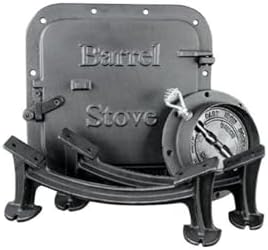
Best for: DIY camp stoves, workshops, and nonresidential outbuildings
The US Stove BSK1000 Barrel Stove Kit is a smart value pick for hands-on buyers, but it is important to understand what you are buying: This is a conversion kit, not a complete wood stove. You supply a compatible 36- or 55-gallon steel drum, then use the included cast-iron hardware to turn it into a basic wood-burning camp stove.
For the right person, this can be a satisfying, low-cost project. If you already have access to a clean, suitable steel drum and are comfortable with cutting, drilling, sealing, and installing a flue, the BSK1000 can produce a large, functional stove for a hunting camp, an outdoor work area, or a detached nonresidential structure.
Key Features:
- Compatible with 36- and 55-gallon steel drums
- Heavy-duty cast-iron components
- Includes a door, legs, flue collar, damper, and mounting hardware
- Uses a 6-inch flue
- Carry case and cleaning accessories included
- Compatible with the optional BKAD500 double-barrel adapter
Real-World Use Notes
What makes this kit appealing is its flexibility. A 55-gallon drum can create a much larger firebox than many portable camping stoves, which can be helpful for a workshop or a longer stay at a camp. The optional double-barrel adapter may also appeal to DIY users looking to increase heating potential.
That said, it requires real work. You will need to prepare the barrel, cut the necessary openings, mount the door and legs, install the flue collar, seal the connections, and build a safe venting system. This is not the product I would recommend to someone who wants a stove delivered, assembled, and ready to burn.
Also, the barrel itself is sold separately. Factor that into the total cost, along with the chimney pipe, heat shielding, floor protection, tools, and any other necessary installation materials.
Keep in Mind:
- The steel barrel is not included.
- This kit is not EPA certified.
- It is not intended for residential indoor use.
- Manufacturer restrictions apply in Washington, Oregon, and California.
- Safe DIY assembly, proper clearances, and correct flue installation are critical.
3. Best Heavy-Duty Portable: VEVOR Alloy Steel Camping Wood Stove

Best for: Larger hot tents and frequent cold-weather camping
The VEVOR Alloy Steel Camping Wood Stove is the portable pick I would look at when a larger firebox matters more than keeping every ounce of gear to a minimum. With a 1,400-cubic-inch firebox, 3-millimeter reinforced panels, and eight chimney sections, it is built for shoppers who spend more than an occasional mild-weather weekend outdoors.
At approximately 26.68 pounds with accessories, this is a car-camping stove rather than a backpacking stove. But that additional size and weight can pay off when temperatures drop: A larger firebox can hold more fuel and potentially reduce the number of times you need to interrupt your evening—or sleep—to add wood.
Key Features:
- Alloy-steel construction
- 1,400-cubic-inch firebox
- 3-millimeter reinforced panels
- Eight chimney pipes
- Approximately 26.68 pounds with accessories
- Flat cooking surface
- Package may include gloves and chimney components
Real-World Use Notes
This is the kind of stove that feels better suited to a roomy hot tent, a hunting camp, or a cold-weather base camp than a one-night minimalist setup. The larger firebox gives it a practical advantage over smaller tent stoves, particularly when you want a longer heating cycle and less frequent refueling.
I also like the reinforced-panel approach for repeated outdoor use. A stove that gets loaded into a truck, set up on uneven ground, and exposed to changing weather needs a more substantial build than a thin, occasional-use camp stove.
The tradeoff is obvious: It is heavier and bulkier than a compact stainless-steel option. If you are carrying all your gear long distances, it is probably too much stove. If you are driving to your campsite or hauling equipment by ATV, that extra capability is much easier to justify.
Keep in Mind:
- It is heavier than many compact tent stoves.
- Alloy steel benefits from regular cleaning and dry storage to help prevent rust.
- It is not designed as a permanent residential indoor heater.
- Heat performance depends on firewood quality, tent size, insulation, weather, and chimney draft.
4. Best Lightweight Stainless: VEVOR Stainless Steel Camping Wood Stove

Best for: Outdoor cooking and heating in damp or humid conditions
The VEVOR Stainless Steel Camping Wood Stove is the more practical choice for campers who prioritize corrosion resistance and easier off-season storage. Where the alloy-steel VEVOR model leans toward a larger, more robust firebox setup, this stainless-steel option is better suited to shoppers who want a portable stove that can tolerate regular exposure to damp campsites, humid garages, vehicle storage, or coastal air.
Stainless steel is especially helpful if your outdoor gear does not always get stored in a perfectly dry, climate-controlled space. It will not make the stove maintenance-free, but it can be a better fit for rainy climates and frequent outdoor use than a basic carbon-steel alternative.
Key Features:
- Stainless-steel construction
- Portable design
- Chimney-pipe system for tents and outdoor shelters
- Flat cooking surface
- Outdoor-focused build
- Available in different firebox sizes and configurations, depending on the model
Real-World Use Notes
This is a strong middle-ground choice. It offers more capability and durability than a bare-bones budget stove, while remaining far easier to transport and manage than a permanent cast-iron home heater.
For a camper who stores gear in a shed, garage, truck bed, or enclosed trailer, stainless steel can provide some added peace of mind. It is also a logical option for users in wet climates, coastal areas, or places where camping gear may sit unused for several months between trips.
Before ordering, I would double-check the exact model listing. VEVOR sells several similarly named stainless-steel tent stoves, and specifications can differ in firebox size, chimney length, included accessories, dimensions, and weight.
Keep in Mind:
- Specifications can vary substantially between VEVOR stainless-steel models.
- Stainless steel can discolor from repeated high heat.
- It is not a certified residential indoor heating appliance.
- Tent-wall spacing, chimney exits, heat shields, and floor protection still matter.
5. Best Indoor / Small Spaces: Cleveland Iron Works H090 Erie

Best for: Small homes, cabins, workshops, and indoor spaces up to 900 square feet
The Cleveland Iron Works H090 Erie is the standout indoor-heating choice in this lineup because it is built for a completely different job than the portable camp stoves above. This is an EPA-listed and approved cast-iron wood stove designed for permanent, properly vented residential-style installation—not temporary use in a tent or backyard shelter.
Its stated heating capacity of up to 900 square feet makes it a compelling option for a small cabin, compact house, insulated workshop, or modest living area. It also accepts logs up to 18 inches long, which is a meaningful convenience over smaller portable stoves that demand shorter wood pieces and frequent tending.
Key Features:
- EPA listed and approved
- Rated to heat spaces up to 900 square feet
- Cast-iron construction
- Accepts logs up to 18 inches long
- Single-burn-rate design
- Cool-touch two-piece safety handle
- Reported average efficiency of 68% HHV and 72.71% LHV
- One-year limited warranty
- No blower or thermostat included
Real-World Use Notes
I like this stove for buyers who want the comfort and visual appeal of traditional wood heat without installing an oversized unit in a smaller space. The cast-iron construction gives the H090 a more substantial, permanent feel than a sheet-metal tent stove, and it makes sense in settings where the stove will become part of the room rather than a piece of seasonal gear.
The roughly 150-pound weight is worth noting. It suggests a serious, sturdy build, but it also means this is not something you casually move from room to room. Plan for delivery, a compliant hearth, chimney routing, and installation before it arrives.
Its single-burn-rate design keeps operation straightforward, though it does not offer the same degree of automated comfort as a pellet stove or a smart thermostat-controlled heating system. It is best for buyers who want a hands-on, traditional heating appliance and are prepared to manage firewood, ash, and routine maintenance.
Keep in Mind:
- A compliant chimney system and professional installation are essential.
- At about 150 pounds, it is heavy and not portable.
- It does not include a blower.
- It does not include a thermostat.
- Real-world heating performance depends on insulation, ceiling height, floor plan, climate, and the moisture content of your firewood.
6. Best Value: Guide Gear Outdoor Wood-Burning Stove

Best for: Budget-conscious campers, hunters, and outdoor cooks
The Guide Gear Outdoor Wood-Burning Stove is the value-minded choice for shoppers who want basic outdoor heat and a cooking surface without paying for a premium hot-tent stove. It is designed for seasonal, temporary use in camping, hunting, fishing, and outdoor shelter setups—not for permanent installation inside a home.
Its appeal is straightforward: Feed it wood, vent it correctly, and use the top surface to boil water, heat a meal, or keep a kettle warm while the stove heats your outdoor setup. For buyers who camp occasionally and do not need the larger firebox or premium materials of more expensive models, that simplicity can be exactly what they need.
Key Features:
- Budget-focused outdoor design
- Wood-burning fuel system
- Chimney pipe included with listed configurations
- Cooking surface
- Direct-vent setup
- Assembly required
- Larger version available for greater capacity
Real-World Use Notes
This is a sensible option for campers and hunters who value usefulness over refinement. The cooking surface makes it more versatile than a standalone heater, particularly when you want to boil water or make easy meals without adding a separate stove to your packing list.
Because the design is comparatively simple, I would make a point of inspecting it before every trip. Check the legs, door, seams, chimney sections, and any fasteners for looseness, warping, corrosion, or wear. A low-cost stove can be a great value, but it should not be treated casually around heat, fire, fabric, or enclosed shelters.
The larger version may be appealing if you need more heating potential, but remember that capacity usually comes with a transport penalty. A bigger stove can be more useful at camp, yet more awkward to load, unload, and store at home.
Keep in Mind:
- It is not EPA certified for residential heating.
- Assembly is required.
- Larger versions are less convenient to transport.
- Included pipes, accessories, and specifications can vary by retailer and model.
- It is best for outdoor, temporary, and seasonal use—not permanent indoor installation.
How We Chose These Wood Burning Stoves
A wood stove can be a cozy cabin upgrade, a useful emergency-heat source, or the centerpiece of a cold-weather camp—but those are very different jobs. For this roundup, I did not treat every stove as though it belonged in every setting. Instead, I looked at where each model is meant to operate, what it is made from, how much wood it can reasonably burn, what comes in the box, and—most importantly—whether it is appropriate for residential indoor use.
That distinction matters. Portable tent stoves can be excellent for cooking and heating a temporary outdoor shelter, but they should not be treated as interchangeable with an EPA-certified wood stove installed in a home or cabin. EPA-certified residential wood stoves are independently tested to meet emissions standards, while portable camp stoves and barrel-stove kits are generally designed for temporary outdoor or nonresidential use.
Use-Case Fit
The first question I asked was simple: Where will this stove actually live and operate?
A compact stainless-steel tent stove may be the right choice for a weekend hunting camp, ice-fishing shelter, hot tent, or car-camping setup. These stoves are designed to be transported, assembled at camp, and packed away after the trip. Their strengths are portability, quick heating, chimney systems that break down into sections, and flat tops that can double as simple outdoor cooktops.
For a small cabin, workshop, or compact home, I looked for a fundamentally different kind of product: a residential stove designed for permanent placement and proper chimney installation. The Cleveland Iron Works H090 Erie falls into that category. It is EPA listed and approved, uses a cast-iron body, and is rated for indoor heating in spaces up to 900 square feet.
The US Stove BSK1000 fits another category altogether: the DIY project. It converts a 36- or 55-gallon drum into a camp stove, making it appealing for a hunting camp, temporary work area, or suitable detached nonresidential building. The manufacturer is clear, however, that it is not EPA certified and is not designed for residential use.
Materials and Durability
Material choice affects much more than appearance. It influences how much the stove weighs, how it holds up to repeated heating cycles, how easily it can be moved, and whether it needs extra care during storage.
- Cast iron is the traditional choice for permanent indoor heating. It is heavy, durable, and gives a residential stove a substantial, long-term feel. The downside is portability: A roughly 150-pound cast-iron unit such as the Cleveland Iron Works H090 is a permanent-installation appliance, not something you toss in the truck for a weekend trip.
- Alloy steel is a strong option for more substantial portable stoves. It can make sense for larger hot tents, hunting camps, and frequent car-camping setups where a bigger firebox and reinforced panels are worth carrying extra weight. The tradeoff is that steel may need more diligent cleaning and dry storage to prevent surface rust.
- Stainless steel is especially attractive for campers who store equipment in humid garages, sheds, trailers, truck beds, or coastal climates. It is generally more corrosion resistant than untreated steel and keeps a portable stove manageable enough for outdoor use. It can still discolor with high heat, though, and it is not immune to warping if repeatedly overheated.
- Barrel-stove construction prioritizes low cost and DIY flexibility. A steel drum can create a large firebox at a budget-friendly price, but the final stove’s quality depends heavily on the barrel, the assembly work, the flue setup, and how carefully the user follows safe-clearance requirements.
In practical terms, I favor cast iron for permanent home or cabin use, stainless steel for wet-weather camping and easier storage, alloy steel for more demanding car-camping use, and a barrel kit only for an informed DIY buyer with an appropriate nonresidential application.
Heating and Firebox Capacity
Firebox size is one of the most important specifications to consider because it affects how often you will need to add wood. A larger firebox can typically hold more fuel, which is useful during long, cold evenings at camp or when heating a larger outdoor shelter. It can also mean fewer interruptions for refueling.
The VEVOR Alloy Steel Camping Wood Stove stands out here with its 1,400-cubic-inch firebox. That capacity makes more sense for a larger hot tent, an extended hunting trip, or a cold-weather car-camping base camp than a small, ultralight-style stove. The tradeoff is easy to predict: more capacity usually means more steel, more weight, and more bulk.
Smaller portable stoves, including compact hot-tent models, are easier to move and faster to set up, but they are generally more hands-on. Expect to split wood shorter, refuel more often, and manage the fire more closely—particularly overnight.
For residential use, the conversation changes. The Cleveland Iron Works H090 Erie accepts logs up to 18 inches long and is rated for spaces up to 900 square feet, which is more relevant for a small cabin, workshop, or well-insulated living space than a tent-stove firebox measurement. Still, square-foot ratings are not guarantees. Insulation, ceiling height, room layout, climate, window quality, chimney draft, and firewood moisture all influence actual heating performance.
Portability and Setup
“Portable” means different things depending on how you travel.
For car camping, a 20- to 30-pound stove can be entirely reasonable. You can load it into an SUV, pickup, trailer, or RV, carry it from the parking area to camp, assemble the chimney sections, and enjoy a more capable heating and cooking setup. The AVOFOREST Hot Tent Stove and VEVOR camping models fit this type of portability well.
For backpacking, even a 20-pound stove is usually unrealistic once you add chimney pipes, heat shielding, fuel, cookware, food, and other shelter gear. None of the larger camp stoves in this guide should be treated as ultralight backpacking equipment.
I also factored in setup complexity:
- Detachable chimney sections are easier to pack but must be assembled correctly every time.
- Adjustable legs are helpful on uneven ground.
- Folding or removable components simplify storage.
- Larger fireboxes generally add transport bulk.
- Barrel kits require the most effort because the buyer must source the drum and handle the cutting, hardware installation, sealing, and flue connection.
- Residential stoves require the most planning overall, because they need a compliant hearth, chimney system, required clearances, and professional installation or inspection.
A stove is only “easy” if it matches your setup. A heavy outdoor stove can be simple when your vehicle is parked nearby; that same stove becomes a poor choice when you need to carry it a mile to a backcountry site.
Cooking Functionality
For outdoor shoppers, I gave extra credit to stoves with a usable flat-top cooking surface. Even a modest stove can become much more versatile if it lets you boil water, heat coffee, warm soup, melt snow, or cook a basic skillet meal.
The best tent stoves do not replace a full outdoor kitchen, but they can reduce the amount of gear you pack. A flat surface that holds a kettle or small pot is particularly useful on cold mornings, when you want heat and breakfast from the same fuel source.
When comparing cooking capability, I looked at:
- The usable size and stability of the top surface.
- Whether pots and kettles can sit securely.
- Access to the firebox while cookware is in place.
- Whether the stove is tall enough to cook comfortably.
- How much heat control the door and damper provide.
- Whether the stove’s form factor is better for quick boiling or longer simmering.
For the Cleveland Iron Works H090, the cooktop is better thought of as a bonus surface for emergency water heating or simple warming—not the primary reason to buy the stove. Portable camping stoves, by contrast, often make their flat tops a central part of their value.
Value and Included Accessories
I also looked beyond the listed stove price. A less expensive stove can become costly if it requires chimney sections, a spark arrestor, gloves, floor protection, a carry bag, a stove mat, or other essentials that are sold separately.
The more complete portable packages can include practical extras such as:
- Chimney pipes.
- Gloves.
- Dampers.
- Carry cases.
- Cleaning tools.
- Removable legs.
- Cooking grates or flat-top surfaces.
The US Stove BSK1000 deserves special attention here. The conversion kit includes key components such as the door, legs, flue collar, damper, and mounting hardware, but it does not include the steel drum itself. Buyers should also budget for the appropriate flue system, installation materials, tools, and safety components.
Likewise, a residential stove’s upfront cost is only part of the budget. Indoor buyers need to account for professional installation, a compliant chimney, hearth and floor protection, permits when required, and ongoing inspection and cleaning. That investment is not optional—it is part of selecting a stove that can operate safely in a home or cabin.
Safety and Certification
Safety and intended installation are the final filters—and arguably the most important ones.
The Cleveland Iron Works H090 Erie is the residential-focused choice in this roundup because it is EPA listed and approved for indoor heating. EPA certification means a wood stove has been independently tested against federal emissions standards for residential wood heaters. Current federal standards require new residential wood-heating appliances sold in the United States to meet particulate-emissions limits.
The portable AVOFOREST and VEVOR stoves, the Guide Gear model, and the US Stove BSK1000 barrel kit serve a different purpose. They may be useful for camping, temporary shelters, outdoor cooking, hunting camps, and other outdoor-oriented scenarios, but they should not be treated as permanent indoor home heaters.
The BSK1000 barrel kit is particularly clear-cut: It is not EPA certified and is not designed for residential use. A DIY barrel stove also introduces added responsibility because the builder must ensure proper assembly, clearances, venting, and safe operation.
For any indoor wood-stove installation, I recommend treating the following as non-negotiable:
- Choose an appliance approved for the intended residential use.
- Follow the manufacturer’s clearance, hearth, chimney, and fuel requirements exactly.
- Use a properly designed and installed venting system.
- Install carbon-monoxide alarms outside sleeping areas and on every level of the home.
- Have the stove and chimney inspected and maintained regularly.
- Never use a tent stove, outdoor stove, or improvised barrel stove as a shortcut for indoor residential heating.
What to Look for in a Wood Burning Stove
The best wood-burning stove is not necessarily the biggest, cheapest, or most attractive one—it is the one designed for the exact place you plan to use it. Before comparing firebox sizes, materials, or cooking surfaces, I recommend starting with one question: Will this stove live indoors, in a cabin, in a workshop, or outside at camp?
That answer determines almost every other buying decision, including whether you need an EPA-certified residential appliance, how much portability matters, what chimney system you need, and how much setup you are willing to manage. The EPA advises buyers to consider the size of the space, efficiency, and emissions, and identifies EPA-certified or qualified labels as an important indicator when selecting a residential wood-burning appliance.
Choose by Where You Will Use It
| Use Case | Best Stove Type | Top Priorities |
|---|---|---|
| Small Home or Cabin | EPA-approved residential stove | Certification, heating-area rating, chimney compatibility, clearances, installation |
| Workshop or Outbuilding | Heavy-duty stove or permitted DIY barrel setup | Venting, durability, floor protection, local code compliance |
| Hot Tent or Hunting Camp | Portable tent stove | Packed weight, chimney system, firebox size, heat shields, spark arrestor |
| Car Camping | Portable steel or stainless-steel stove | Cooking surface, quick setup, firebox size, manageable weight |
| Humid or Coastal Storage | Stainless-steel camping stove | Corrosion resistance, dry storage, replaceable chimney parts |
| Budget Outdoor Use | Simple portable outdoor stove | Chimney system, stability, cooking area, replacement parts |
Consider Heating Capacity Carefully
It is tempting to choose a wood stove by looking at one number: the manufacturer’s square-foot heating claim. That figure is useful as a starting point, but I would not treat it as a promise that the stove will heat every 900-square-foot cabin, 500-square-foot workshop, or 12-by-12-foot tent the same way.
A stove’s real-world performance depends on the entire space around it—not just the number of square feet on the floor plan.
Look Beyond Square Footage
Before choosing a stove, think through how the building or shelter holds heat.
- Insulation quality: A well-insulated cabin with insulated walls, a sealed door, and modern windows will stay warm far more easily than an older structure with gaps and thin walls.
- Ceiling height: Heat rises. A room with a vaulted ceiling or loft can require more heating capacity than a room with the same floor area and a standard ceiling.
- Climate: A stove that feels more than adequate during a mild fall weekend may struggle during a windy, below-freezing winter night.
- Room layout: An open-plan cabin lets heat move more freely. Separate rooms, long hallways, closed doors, and partitioned workspaces can trap heat near the stove.
- Window quality: Older or single-pane windows can create major heat loss, especially overnight.
- Building exposure: A small cabin on an exposed ridge, beside a lake, or in an open clearing may lose heat faster than one protected by trees or nearby structures.
For example, the Cleveland Iron Works H090 Erie is rated for spaces up to 900 square feet, but that does not mean every 900-square-foot cabin will feel equally warm. A compact, well-insulated cabin with standard ceilings may be an excellent match. A drafty, open-concept cabin with tall ceilings and lots of glass may need a different heating plan.
Match the Stove to the Job
For a home, cabin, or workshop, choose a residential stove based on the actual space, insulation, local climate, and installation requirements—not simply the largest square-foot rating you can afford. The EPA similarly recommends considering the size of the space you need to heat, as well as appliance efficiency and emissions, when selecting a wood-burning appliance.
For portable stoves, manage expectations. A small tent stove can create a warm, comfortable zone in the immediate area around it, but it is not intended to provide whole-home comfort or maintain even temperatures across multiple rooms. In a hot tent or hunting shelter, you will generally feel the strongest heat closest to the stove and cooler conditions near walls, doors, and sleeping areas.
If overnight comfort matters, firebox capacity becomes more important than minimum packed weight. A larger firebox can hold more wood, potentially lengthening the burn interval and reducing the number of times you need to refuel. That is why a bigger camping stove can make sense for extended hunting trips, larger hot tents, and colder weather.
The tradeoff is portability. More firebox volume usually means a heavier stove, more chimney sections, greater floor-space demands, and more effort during transport. For a one-night car-camping trip, a compact stove may be the smarter choice. For several cold nights in a large tent, the extra bulk of a bigger stove may be worth it.
Check Chimney and Venting Requirements
A wood stove is only as safe and effective as its venting system. In my view, the chimney and flue should be part of the purchase decision—not an afterthought once the stove arrives.
Before buying, confirm the stove’s required flue diameter and make sure the included pipe system actually matches your intended setup. A 6-inch flue requirement, for example, is not interchangeable with whatever pipe happens to be available in the garage.
Confirm What Comes With the Stove
Portable tent stoves often include chimney sections, but packages vary widely. Check whether the listing includes:
- The required number of chimney pipe sections.
- A spark arrestor or rain cap, if needed for your setup.
- Pipe supports or guy lines.
- A damper.
- A compatible tent-stove jack or heat-protection component.
- Replacement pipe availability.
- Storage bags or cases for transporting the chimney.
I always recommend confirming that replacement chimney sections are available before committing to a tent-stove system. Chimney parts are among the components most likely to get bent, misplaced, damaged, or worn during transport and repeated setup. A stove that is otherwise in good shape becomes much less useful if you cannot replace one essential pipe section.
Plan the Chimney Route Before Buying
For a tent, outdoor shelter, cabin, or workshop, the chimney exit should be planned before you light the first fire.
For a tent stove, that means using a shelter specifically designed with a compatible stove jack, maintaining the clearances specified by both the tent and stove manufacturers, and keeping hot pipe well away from fabric, guy lines, branches, and other combustibles. The U.S. Forest Service cautions that fuel-burning appliances must be kept far enough from tents to prevent ignition from sparks, flames, and heat.
For a cabin or home, a permanent installation needs a correctly designed chimney system, appropriate roof penetration, and required clearances through walls, ceilings, and roofing materials. A chimney should not be improvised from mismatched pipe sections, dryer vent components, thin ductwork, or other materials not rated for wood-stove temperatures.
Never try to “make it work” with incompatible venting materials. Improvised venting can lead to poor draft, smoke backdrafting, excess creosote, damaged pipe, fire risk, and carbon-monoxide exposure. Follow the stove manufacturer’s specified flue diameter, chimney type, connector requirements, and installation instructions exactly.
Prioritize Safe Operation
Wood heat is rewarding, but it is not set-it-and-forget-it heat. Safe operation begins with buying the right stove for the setting and continues with correct installation, routine inspections, proper fuel, and an honest assessment of what the stove is designed to do.
Use the Right Stove Indoors
For permanent indoor heating, use an EPA-certified appliance where required and choose a stove specifically designed for residential use. EPA-certified stoves have been independently tested to meet applicable emissions requirements, while tent stoves, portable camp stoves, and barrel-stove kits serve different purposes.
Follow the manufacturer’s installation manual for:
- Hearth and floor protection.
- Clearance from walls, ceilings, furniture, curtains, and other combustibles.
- Chimney routing and connector-pipe requirements.
- Approved fuel types.
- Ash removal and maintenance procedures.
- Maximum loading and operating guidance.
For homes, cabins, and other permanent installations, professional installation and inspection are worth the expense. An experienced installer can identify clearance problems, draft issues, incompatible chimney components, and local permitting requirements before they become dangerous or expensive.
Use Carbon-Monoxide and Smoke Alarms
A wood-burning appliance should always be paired with working smoke and carbon-monoxide alarms. The EPA recommends installing smoke and carbon-monoxide detectors on every floor of the house and outside each bedroom.
Test alarms regularly, replace batteries as required, and do not place them where routine cooking smoke or appliance heat will cause you to disable them. A carbon-monoxide alarm is not a substitute for proper venting, but it is an essential safety backstop if a chimney becomes blocked, draft changes, or combustion gases enter the living space.
Inspect Before Every Season
For residential stoves, the EPA recommends having the wood-burning appliance and chimney inspected annually. For outdoor stoves, I would make a similar inspection part of your first trip of the season
Before lighting a fire, inspect:
- Stove body for cracks, warped panels, corrosion, or loose fasteners.
- Chimney sections for dents, holes, creosote buildup, and secure connections.
- Joints, seams, and gaskets for leaks.
- Legs and supports for stability.
- Door latch and hinges for smooth operation.
- Damper movement and airflow control.
- Spark arrestor or rain cap, if included.
- Floor protection and nearby clearances.
Do not ignore a wobbly leg, damaged pipe section, warped door, or poorly fitting chimney joint. Small issues can become serious when the stove is operating at high temperatures.
Burn the Right Wood
Use dry, properly seasoned firewood. The EPA specifically advises burning only dry, seasoned wood, which burns more efficiently and produces less smoke than wet wood
Avoid burning:
- Wet or green wood.
- Pressure-treated lumber.
- Painted, stained, or varnished wood.
- Plywood, particleboard, or other engineered wood.
- Household trash.
- Plastics, cardboard packaging, or construction debris.
Wet wood makes a fire harder to maintain, creates more smoke, lowers heat output, and can contribute to creosote buildup inside the chimney. Treated or painted lumber and household waste can release harmful chemicals when burned.
The simplest rule is also the safest: use the correct stove, the correct venting system, and clean, dry firewood. That combination will make any wood-burning setup more efficient, more comfortable, and much safer.
Final Verdict
The best wood-burning stove for you comes down to one thing: where you plan to use it. Portable tent stoves are excellent for heating a hot tent, cooking a campsite meal, or making a hunting shelter more comfortable, but they are not substitutes for a properly installed residential wood stove. For a home or cabin, prioritize an EPA-approved model designed for permanent indoor use; for camping, prioritize transportability, firebox size, chimney setup, and practical cooking features.
For most campers, I would start with the AVOFOREST if portability and cooking matter equally, or the VEVOR Alloy Steel model if cold-weather capability and firebox capacity are the priority. For a small cabin or home, skip the portable camp-stove category altogether and choose the Cleveland Iron Works H090 Erie with a professionally planned indoor installation.