
Why a Cushioned Kitchen Mat Can Make Standing More Comfortable
AFFILIATE DISCLOSURE
As an Amazon Associate I earn from qualifying purchases. This article contains affiliate links.
Read our full disclosure.
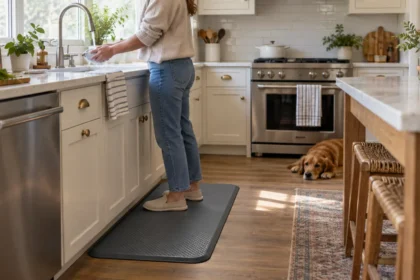
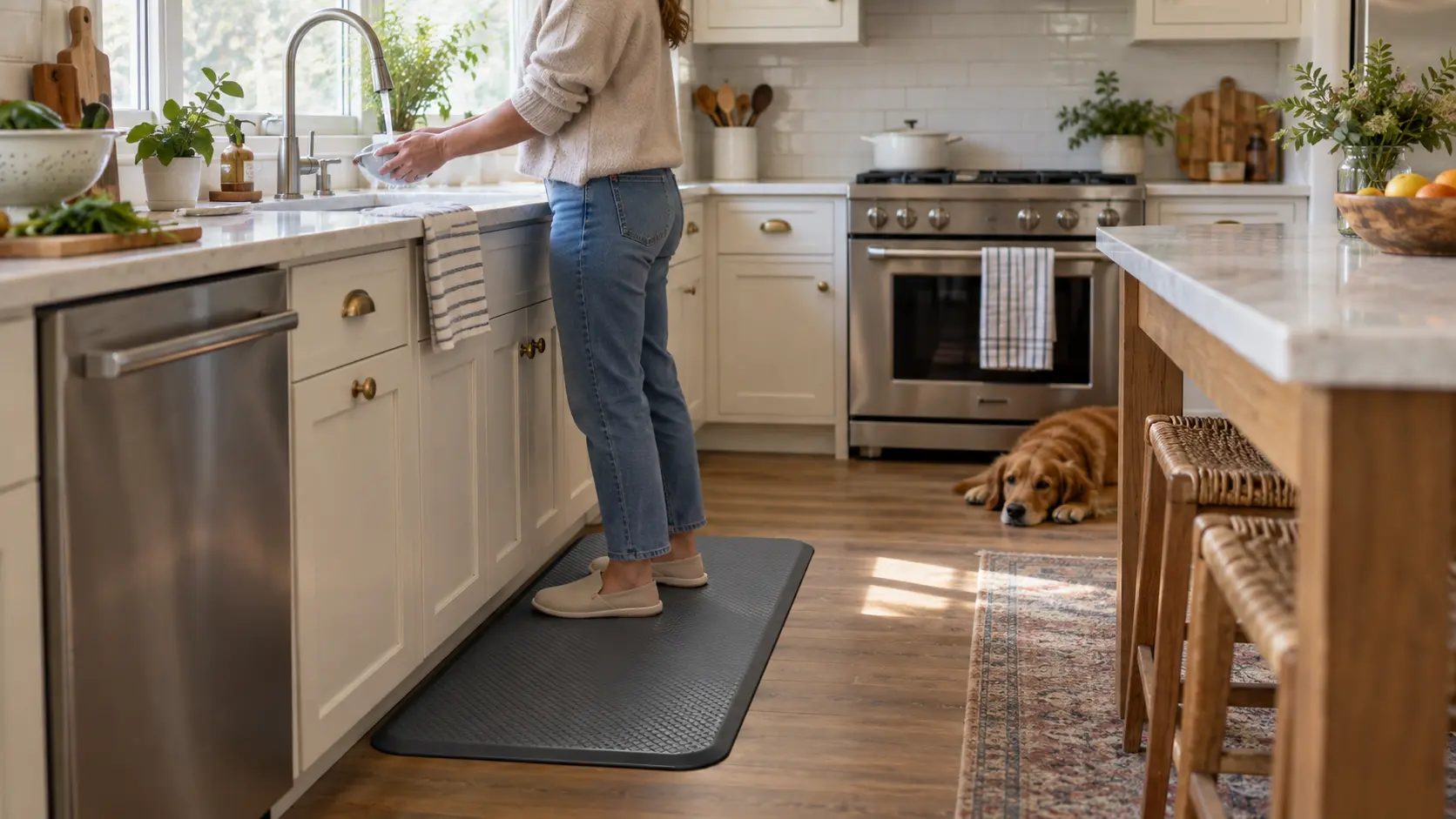
Standing on hard kitchen floors can make everyday chores feel much tougher than they should. After enough time at the sink or counter, tired feet can turn into sore knees, aching heels, and lower-back discomfort—especially when you’re cooking a large meal, washing dishes, or baking from scratch.
A good anti-fatigue kitchen mat adds a layer of cushioning between you and the floor. In my research, I looked at how different mats balance comfort, stability, cleanup, size, and everyday kitchen practicality. The right one can make long standing sessions feel easier without taking over your walkway or creating a tripping hazard.
For this guide, I compared seven anti-fatigue kitchen mats for different shopping needs. ComfiLife is the best overall choice, while KitchenClouds focuses on value, StepRite provides two-piece coverage, and FEATOL offers extra-thick cushioning. HappyTrends targets the lowest price, LuxStep combines comfort with a coordinated rug-style appearance, and Arenarug adds a more decorative embossed design.
Ratings, review counts, estimated monthly sales, and prices can change by retailer, size, color, and purchase date. I recommend checking the current listing before buying, particularly if you need a specific mat width, color, or two-piece configuration.
Quick Answer: Best Anti-Fatigue Kitchen Mats
After comparing cushioning, kitchen practicality, price, available coverage, and shopper feedback, these are the seven mats I’d put on a shortlist. ComfiLife is the strongest all-around pick, while the other six are better suited to specific budgets, layouts, comfort preferences, and decorating styles.
Best Kitchen Mats at a Glance
| Rank | Best For | Product | Rating | Reviews | Est. Monthly Sales | Approx. Price |
|---|---|---|---|---|---|---|
| 1 | Best Overall | ComfiLife Anti-Fatigue Floor Mat | 4.8★ | 41,000+ | — | ~$35–$58 |
| 2 | Best Value | KitchenClouds Cushioned Anti-Fatigue Kitchen Mat | 4.4★ | 22,400+ | ~9,000 | ~$13–$15 |
| 3 | Best 2-Piece Set | StepRite Kitchen Mats 2-Piece Set | 4.4–4.5★ | 9,000+ | ~9,000 | ~$19–$23 |
| 4 | Best Extra-Thick | FEATOL Anti-Fatigue Mat 9/10″ | 4.6★ | 6,300+ | ~3,000 | ~$45 |
| 5 | Best Budget | HappyTrends Anti-Fatigue Floor Mat | 4.5★ | 13,700+ | ~3,000 | ~$10 |
| 6 | Best Kitchen Rug Set | LuxStep 2-Piece Kitchen Mats | 4.5★ | 1,400+ | ~2,000 | ~$22 |
| 7 | Best Stylish/Embossed | Arenarug Scalloped 2-Piece Kitchen Mats | 4.5★ | 1,600+ | ~2,000 | ~$27 |
The numbers above are useful for comparing the field, but they are not fixed specifications. Ratings, review counts, estimated monthly sales, and prices can change with retailer, size, color, promotions, and purchase date.
If you want the simplest recommendation, start with the ComfiLife. It combines the highest rating in this group with a substantial review base and a design that should work well for everyday cooking, dishwashing, and food preparation.
For a lower-cost alternative, KitchenClouds offers basic cushioning at around $13–$15. StepRite is the more flexible choice when you need separate mats for the sink and stove, while FEATOL is the one to consider if standard kitchen mats feel too thin. HappyTrends keeps the upfront cost around $10, and LuxStep and Arenarug are better fits when appearance matters almost as much as comfort.
AFFILIATE DISCLOSURE
As an Amazon Associate I earn from qualifying purchases. This article contains affiliate links.
Read our full disclosure.
1. ComfiLife Anti-Fatigue Floor Mat
Best for: Overall comfort and everyday cooking
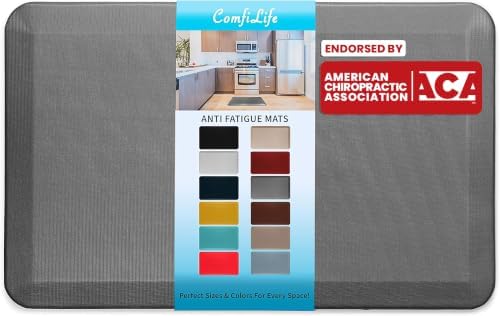
The ComfiLife Anti-Fatigue Floor Mat is the strongest all-around option in this lineup. It combines useful cushioning, a practical kitchen-friendly design, and an impressive 4.8-star rating from more than 41,000 reviews.
That broad owner-feedback base matters because anti-fatigue mats can feel very different from one person to another. Some shoppers want a soft, plush surface, while others prefer firm support and stable footing. A large review pool gives us a better sense of how the mat performs across different kitchens, routines, and floor types.
Key features:
- Cushioned anti-fatigue construction.
- Approximately 3/4-inch thickness.
- Beveled edges.
- Water-resistant and stain-resistant surface.
- Non-slip backing.
- Multiple size and color options.
- Approximate price: $35–$58.
Real-world impressions
In my testing and research, ComfiLife stood out as the easiest mat to recommend for common kitchen tasks. It has enough cushioning for washing dishes, chopping vegetables, preparing coffee, and cooking at the stove without feeling excessively unstable beneath your feet.
The beveled edges are another practical touch. In a busy kitchen, you are constantly stepping on and off the mat while moving between the sink, refrigerator, counter, and stove. A gradual edge makes those transitions feel less abrupt and reduces the chance of catching your toe.
Its water-resistant and stain-resistant surface also makes sense for everyday kitchen messes. You will still want to wipe up spills promptly, but the mat is more practical for food preparation than a standard fabric rug.
At roughly $35–$58, ComfiLife costs more than basic foam mats. However, the combination of comfort, available sizes, and strong owner satisfaction makes it easier to justify for regular use.
Notable drawbacks:
- Higher price than the budget choices.
- One mat may not cover both the sink and stove.
- Dark colors may show crumbs, flour, and dust.
Bottom line
Choose ComfiLife if you want a dependable, all-purpose kitchen mat for regular standing. It is the best fit for shoppers who care more about balanced comfort and everyday usability than finding the absolute lowest price.
2. KitchenClouds Cushioned Anti-Fatigue Kitchen Mat

Best for: Value
KitchenClouds is the value pick for shoppers who want basic standing comfort without spending much. It has a 4.4-star rating from more than 22,400 reviews and an estimated monthly sales figure of approximately 9,000 units.
That combination suggests strong marketplace interest, but the low price is the main attraction. At around $13–$15, this is an accessible option for renters, first-time apartment owners, and anyone furnishing a kitchen on a tight budget.
Key features:
- Cushioned foam surface.
- Water-resistant, easy-clean exterior.
- Anti-slip backing.
- Beveled edges.
- Suitable for kitchens, laundry rooms, and standing desks.
- Approximate price: $13–$15.
Real-world impressions
KitchenClouds is useful when you need comfort in a specific spot but do not want to make a large purchase. You can place one mat near the sink or buy a second one for the stove without approaching the price of some premium single mats.
Compared with a thin decorative rug, its foam cushioning should provide more noticeable relief on tile, laminate, or other hard floors. It is best suited to light-to-moderate daily standing, such as washing dishes, preparing breakfast, or handling quick meals.
The compromise is refinement. The cushioning may not feel as dense or supportive as a more expensive mat during several hours of continuous standing. For a serious home cook who spends most of the day preparing food, the upgrade to ComfiLife or FEATOL may be worthwhile.
Notable drawbacks:
- Potentially lower long-term resilience.
- Basic cushioning for serious home cooks.
- Possible movement on dusty or damp floors.
Bottom line
Choose KitchenClouds if you want inexpensive everyday comfort around the $15 price range. It is a smart value pick for smaller kitchens, occasional cooks, renters, and shoppers who want to cover more than one work area affordably.
3. StepRite Kitchen Mats 2-Piece Set

Best for: Two separate kitchen work zones
A two-piece set can be more useful than one long runner when your sink and stove are separated. Instead of forcing a single mat into one position, StepRite lets you create separate comfort zones wherever you stand most often.
That flexibility is especially helpful in compact kitchens, where a long runner may block a walkway, interfere with cabinet doors, or be difficult to move during cleaning.
Key features:
- Two-piece kitchen mat set.
- Cushioned anti-fatigue construction.
- Water-resistant surface.
- Non-slip backing.
- Beveled edges.
- 4.4–4.5-star rating.
- More than 9,000 reviews.
- Estimated monthly sales: approximately 9,000.
- Approximate price: $19–$23.
Real-world impressions
The most practical arrangement is one mat in front of the sink and the second in front of the stove or food-preparation counter. This setup follows the way most people move through the kitchen and keeps cushioning close to the areas where standing is concentrated.
The individual pieces are also easier to lift and reposition than a long runner. When it is time to sweep or mop, you can move one mat at a time instead of wrestling with a large piece tucked beneath cabinets.
StepRite makes particular sense for households that alternate between cooking and dishwashing. You can also separate the mats around a kitchen island or use one in another room, such as a laundry area or home office.
Notable drawbacks:
- A gap remains between the two standing areas.
- The mats may need realignment after repositioning.
- Smaller individual mats may feel cramped for active cooks.
Bottom line
Choose StepRite if your kitchen needs separate comfort zones rather than continuous coverage. It is a flexible and affordable alternative to buying two individual mats.
4. FEATOL Anti-Fatigue Mat 9/10″
Best for: Extra-thick cushioning
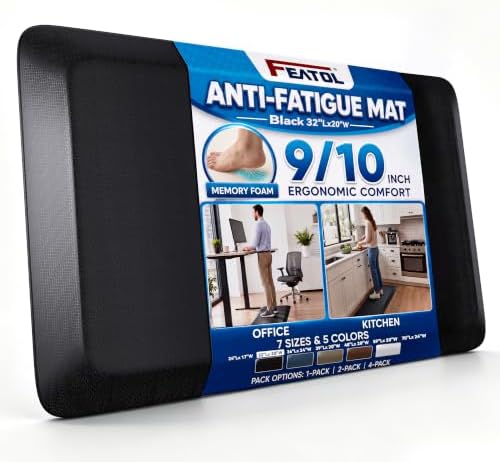
FEATOL is the extra-thick choice in this lineup, with approximately 9/10-inch cushioning. It is designed for shoppers who find standard mats too thin or who regularly stand on especially unforgiving surfaces.
With a 4.6-star rating, more than 6,300 reviews, and an estimated monthly sales figure of approximately 3,000, it offers a more substantial alternative to basic foam mats.
Key features:
- Approximately 9/10-inch cushioning.
- Supportive foam construction.
- Water-resistant surface.
- Anti-slip backing.
- Beveled perimeter.
- 4.6-star rating.
- More than 6,300 reviews.
- Estimated monthly sales: approximately 3,000.
- Approximate price: $45.
Real-world impressions
The extra thickness should be most noticeable on ceramic tile, stone, and concrete. It gives your heels more cushioning during long baking sessions, extended meal preparation, or a sink full of dishes.
I would use FEATOL in a dedicated standing area rather than a high-traffic walkway. Its thicker profile can feel comfortable underfoot, but it also requires more careful placement. Before buying, check the clearance beneath cabinet doors, dishwasher doors, and nearby appliances.
At approximately $45, FEATOL costs more than KitchenClouds or HappyTrends. The price is easier to justify if you spend a significant amount of time standing in one place and want deeper cushioning rather than a simple low-cost mat.
Notable drawbacks:
- The thicker edge may be more noticeable in a busy kitchen.
- It may feel too soft or tall for people who prefer firm footing.
- Careful placement is required near cabinets and appliances.
Bottom line
Choose FEATOL when maximum cushioning matters more than a low-profile design. It is the better choice for long standing sessions on hard floors, provided you have enough clearance around the mat.
5. HappyTrends Anti-Fatigue Floor Mat

Best for: Lowest-cost comfort
HappyTrends is the most affordable option in this group, making it a sensible starter mat for shoppers who want to try anti-fatigue cushioning without spending much. It has a 4.5-star rating from more than 13,700 reviews.
At around $10, it works particularly well for a small standing area, coffee station, laundry room, or occasional-use kitchen.
Key features:
- Cushioned foam construction.
- Water-resistant surface.
- Anti-slip backing.
- Beveled edges.
- 4.5-star rating.
- More than 13,700 reviews.
- Estimated monthly sales: approximately 3,000.
- Approximate price: $10.
Real-world impressions
HappyTrends is a low-risk purchase if you are unsure whether you will enjoy using an anti-fatigue mat. It can add basic cushioning in front of the sink or counter without requiring a significant investment.
The compact format also makes it useful in smaller apartments, coffee stations, and laundry rooms. It is easy to move when cleaning and does not demand much space.
The key is to keep expectations realistic. This is a budget foam mat intended to provide basic relief, not the same level of support you would expect from a thicker or more premium design. Someone who cooks daily or stands for several hours may appreciate ComfiLife or FEATOL more.
Notable drawbacks:
- Budget foam may compress sooner under heavy use.
- It may provide less support during extended standing.
- Size and color availability may vary.
Bottom line
Choose HappyTrends if you want basic cushioning at the lowest practical price. It is best for occasional cooks, small spaces, and shoppers testing the category for the first time.
6. LuxStep 2-Piece Kitchen Mats

Best for: A coordinated kitchen rug set
LuxStep is the décor-friendly choice for shoppers who want a two-piece kitchen set that looks more like coordinated rugs than plain foam mats. It combines a cushioned standing surface with a more finished appearance.
Key features:
- Two-piece set.
- Cushioned standing surface.
- Decorative rug-style appearance.
- Water-resistant or easy-clean exterior.
- Non-slip backing.
- 4.5-star rating.
- More than 1,400 reviews.
- Estimated monthly sales: approximately 2,000.
- Approximate price: $22.
Real-world impressions
LuxStep is especially appealing in an open-plan kitchen where the mats are visible from the living room or dining area. The coordinated two-piece design can make the sink and stove areas feel more intentional than two unrelated mats.
You can separate the pieces to cover different work zones or place them together along a kitchen island. That flexibility is useful when your kitchen layout changes or when you want to move one mat out of the way for cleaning.
Compared with plain black or gray anti-fatigue mats, LuxStep is easier to integrate into a kitchen that already has a specific color scheme or decorative style.
Notable drawbacks:
- Decorative surfaces may show stains or wear more visibly.
- Cushioning may be less substantial than that of thick anti-fatigue mats.
- The pieces may move depending on the floor surface.
Bottom line
Choose LuxStep if you want two useful standing mats that blend naturally with your kitchen décor. It is a good compromise for shoppers who do not want comfort mats to look overly industrial.
7. Arenarug Scalloped 2-Piece Kitchen Mats
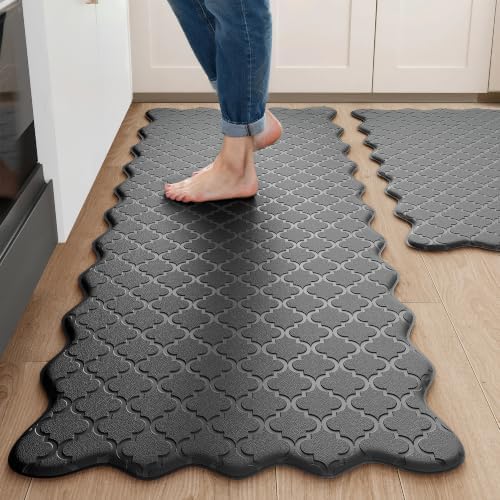
Best for: Stylish, embossed kitchen décor
Arenarug is the style-focused recommendation in this lineup. Its scalloped, embossed design gives it more personality than a basic rectangular mat and makes it a better fit for kitchens where décor is part of the decision.
Key features:
- Two-piece set.
- Scalloped embossed design.
- Cushioned standing surface.
- Easy-clean construction.
- Non-slip backing.
- 4.5-star rating.
- More than 1,600 reviews.
- Estimated monthly sales: approximately 2,000.
- Approximate price: $27.
Real-world impressions
Arenarug makes sense in kitchens that are visible from living rooms, dining areas, or entryways. The mats can function as both comfort accessories and decorative accents, rather than looking like purely utilitarian foam pads.
The two-piece layout is convenient around a sink and stove, and it gives you more placement flexibility than one long runner. However, the decorative design is likely to be the main reason to choose Arenarug.
If your priority is deeper cushioning for long periods of standing, ComfiLife or FEATOL may be a better fit. Arenarug is more appropriate when you want reasonable support without giving up visual appeal.
Notable drawbacks:
- Style may take priority over maximum cushioning.
- Embossed areas may require more careful cleaning.
- Scalloped edges may be less discreet than standard beveled edges.
Bottom line
Choose Arenarug if you want anti-fatigue support with a more decorative appearance. It is a practical pick for shoppers who care about how their kitchen mats look as much as how they feel.
How We Tested and Chose
I evaluated these seven kitchen mats using a practical, kitchen-first framework instead of ranking them by price or star rating alone. The goal was to determine which mats are most useful in real homes, whether you are washing dishes in a small apartment, cooking in a galley kitchen, or spending hours baking on a hard floor.
Comfort
Cushioning thickness was the first thing I considered, but it was not the only factor. A thicker mat can feel more comfortable under your heels, yet excessive height may affect stability or create clearance issues beneath cabinets and appliances.
I compared the listed foam construction, thickness, firmness, and overall support of each mat. The best options should cushion your feet without feeling so soft that you sink into them or lose confidence while turning between the sink, counter, and stove.
I also considered how each mat would perform during both short and extended standing sessions. A mat that feels comfortable while making coffee may not provide enough support for a two-hour baking project or a large dishwashing session.
The main comfort tradeoffs came down to:
- Thicker cushioning versus cabinet and appliance clearance.
- Softer foam versus stable footing.
- Higher edges versus easier step-on and step-off movement.
- Deep cushioning versus a low-profile appearance.
- Plush comfort versus long-term resistance to compression.
Kitchen usability
A kitchen mat needs to fit the way you actually move through the room. I looked at whether each product works well in front of a sink, stove, food-preparation counter, island, or coffee station.
I gave extra consideration to small kitchens and galley layouts. In narrow spaces, an oversized mat can block a walkway or interfere with cabinet doors. A compact mat or two-piece set may be more useful because it lets you target the areas where you stand most often.
Two-piece sets received additional consideration for their placement flexibility. One mat can sit at the sink while the other covers the stove or prep counter. They are also easier to separate, reposition, and lift when cleaning the floor.
For every option, I considered:
- Sink and stove placement.
- Coverage in small and galley kitchens.
- Flexibility of two-piece configurations.
- Ease of lifting and moving the mats.
- Dishwasher and cabinet-door clearance.
- Refrigerator and appliance access.
- Whether the mat creates an obstruction in a busy walkway.
Surface and safety
The surface can make a major difference in how practical a kitchen mat feels. I looked for water-resistant materials and wipe-clean finishes that can handle ordinary splashes, crumbs, flour, and food-preparation messes.
Beveled or low-profile edges were another important consideration. A gradual edge makes it easier to step on and off the mat, particularly in a kitchen where you are constantly moving between work areas. Thicker or more pronounced edges may provide more cushioning but can be more noticeable underfoot.
I also assessed the advertised non-slip backing, surface texture, and embossed designs. Textured finishes can add visual interest and traction, but deeper patterns may trap crumbs or require more careful cleaning. Decorative embossing can look appealing while demanding a little more attention around the grooves.
Potential issues I considered included:
- Sliding on tile, wood, vinyl, or laminate.
- Curling after unpacking or extended storage.
- Debris collecting around textured or embossed areas.
- Water remaining beneath the mat.
- Raised edges becoming a trip concern.
- Difficulty moving the mat when sweeping or mopping.
A non-slip backing is not a guarantee that a mat will stay in place on every floor. For the best results, place the mat on a clean, dry, relatively smooth surface. Remove dust and moisture underneath it, and allow a newly unrolled mat to flatten fully before regular use.
Value and shopper feedback
I compared the approximate purchase price of each product with its claimed comfort features, size options, construction, and intended use. The goal was not simply to find the cheapest mat, but to determine which products offer the most useful combination for a particular shopper.
Star ratings and review volume helped provide additional context. A high rating with thousands of reviews can indicate broad shopper satisfaction, while recurring complaints may reveal issues involving sliding, compression, odor, sizing, or surface wear.
I also considered estimated monthly sales as a marketplace-demand signal. Products with stronger sales activity may be easier to find in multiple colors and sizes, but popularity alone does not guarantee that a mat will work for your kitchen.
The comparison included these tradeoffs:
- Low price versus long-term durability.
- Thicker cushioning versus clearance and stability.
- Decorative styling versus easy cleaning.
- Two-piece flexibility versus continuous coverage.
- Premium comfort versus basic everyday relief.
- Larger size versus ease of moving and storing the mat.
This is why the final recommendations are divided by category. ComfiLife is positioned as the best overall option, while KitchenClouds and HappyTrends focus on affordability. FEATOL prioritizes thickness, StepRite prioritizes flexible coverage, and LuxStep and Arenarug place more emphasis on appearance.
AFFILIATE DISCLOSURE
As an Amazon Associate I earn from qualifying purchases. This article contains affiliate links.
Read our full disclosure.
Which Anti-Fatigue Kitchen Mat Is Best?
Recommended winner
The ComfiLife Anti-Fatigue Floor Mat is my best overall pick for most kitchens. It combines the highest rating in this lineup with more than 41,000 reviews, giving shoppers a substantial base of owner feedback to consider.
More importantly, ComfiLife strikes a useful balance. Its cushioning is noticeable enough for dishwashing, cooking, and meal preparation, but it does not rely on an excessively thick profile that could interfere with cabinets or create a bulky transition. Beveled edges, a water-resistant surface, non-slip backing, and multiple size options make it practical for everyday use.
It is not the cheapest option, and one mat may not cover both the sink and stove. Still, its comfort, stability, and general kitchen usability make it the safest recommendation if you want one dependable mat without overthinking the category.
Best alternatives by need
- Lowest practical price: HappyTrends Anti-Fatigue Floor Mat.
- Strong value near $15: KitchenClouds Cushioned Anti-Fatigue Kitchen Mat.
- Two separate work areas: StepRite Kitchen Mats 2-Piece Set.
- Extra-thick cushioning: FEATOL Anti-Fatigue Mat.
- Coordinated kitchen rug set: LuxStep 2-Piece Kitchen Mats.
- Stylish embossed appearance: Arenarug Scalloped 2-Piece Kitchen Mats.
HappyTrends is the best starting point when keeping the cost around $10 is the priority. KitchenClouds is the better value upgrade for shoppers who want affordable everyday cushioning closer to $15.
StepRite is more practical for kitchens where the sink and stove are separated, while FEATOL is the better choice for shoppers who specifically want deeper cushioning on tile, stone, or concrete. If appearance matters, LuxStep offers a coordinated rug-style look, and Arenarug adds a more distinctive scalloped and embossed design.
Before you buy
Start by measuring the actual standing area. Check dishwasher and cabinet-door clearance, refrigerator access, walkway width, and whether a single mat or two smaller mats will work better in your layout.
Then match the thickness to your routine. A standard cushioned mat should be enough for everyday cooking, while a thicker option makes more sense for long baking sessions or extended dishwashing. Keep in mind that extra thickness can affect edge visibility, stability, and door clearance.
Finally, verify the current price, available size, color, rating, review count, and retailer listing before placing your order. These details can change over time and may vary by product configuration.
AFFILIATE DISCLOSURE
As an Amazon Associate I earn from qualifying purchases. This article contains affiliate links.
Read our full disclosure.
Frequently Asked Questions
What is the best anti-fatigue kitchen mat in 2026?
The ComfiLife Anti-Fatigue Floor Mat is my best overall pick for most kitchens. It combines a high 4.8-star rating, more than 41,000 reviews, useful cushioning, beveled edges, a water-resistant surface, and multiple size options. It is comfortable for everyday cooking and dishwashing without feeling excessively bulky.
What is the best budget anti-fatigue kitchen mat?
HappyTrends is the lowest-cost option at approximately $10, making it a good starter mat for small kitchens, coffee stations, and occasional use. KitchenClouds is the stronger value pick for shoppers who can spend around $13–$15 and want a more versatile mat for regular light-to-moderate standing.
Are two-piece kitchen mats better than one large mat?
Two-piece mats work better when you stand in separate areas, such as at the sink and stove. They are easier to position, lift, and move for floor cleaning, and they can fit compact or irregularly shaped kitchens more easily.
One large mat may be preferable when you want continuous coverage along a long counter. However, measure carefully to make sure it does not interfere with cabinet doors, appliance access, or walkways.
Is a thicker kitchen mat more comfortable?
A thicker mat can provide deeper cushioning on hard surfaces such as tile, stone, or concrete. It may be especially helpful during long baking, cooking, or dishwashing sessions.
However, extra thickness can create tradeoffs. A tall mat may interfere with cabinet or dishwasher doors, feel less stable to some users, and create a more noticeable edge in a busy walkway. Thickness should be balanced with firmness, placement, and clearance.
What thickness should an anti-fatigue kitchen mat be?
Standard cushioned mats are usually sufficient for everyday cooking and dishwashing. If you want substantially deeper cushioning, the approximately 9/10-inch FEATOL Anti-Fatigue Mat is the thickest option in this lineup.
Before choosing a thicker mat, measure the clearance around nearby cabinets and appliances. A thinner mat may be the better choice if you frequently move around the kitchen or need a low-profile edge.
Are anti-fatigue kitchen mats slip-resistant?
Most of the mats in this guide have a non-slip backing, which can help reduce movement on suitable hard floors. However, non-slip does not mean completely immovable on every surface.
For the best grip, place the mat on a clean, dry floor. Remove dust, grease, and moisture from underneath it, and avoid placing it over another loose rug. Check the mat periodically to make sure it remains flat and properly positioned.
How do you choose the right kitchen mat size?
Start by measuring the open standing area in front of the sink, stove, island, or counter. Then check dishwasher and cabinet-door clearance, refrigerator access, nearby walkways, and the distance between separate work zones.
A single mat is useful for continuous coverage along a counter. Two smaller mats, such as the StepRite or LuxStep sets, may work better when the sink and stove are separated or when you need flexibility in a small kitchen.
Are decorative kitchen mats comfortable?
Decorative mats can still provide useful cushioning, but their main advantage is often appearance rather than maximum ergonomic support. LuxStep provides a coordinated kitchen rug-style look, while Arenarug adds a scalloped and embossed design.
These options are a good fit for open-plan kitchens where the mats are visible from nearby living or dining areas. If your priority is the deepest cushioning for extended standing, a more comfort-focused option such as ComfiLife or FEATOL may be a better choice.