
AFFILIATE DISCLOSURE
As an Amazon Associate I earn from qualifying purchases. This article contains affiliate links.
Read our full disclosure.
Why the Right Pot and Pan Organizer Matters
Pot and pan organizers are one of those kitchen upgrades you notice every time you cook. Without one, skillets, saucepans, Dutch ovens, lids, and baking sheets tend to become a heavy, noisy stack that is difficult to reach without pulling half the cabinet apart.
The right organizer changes that setup by giving each piece a designated place. Vertical dividers can keep cookware upright, expandable racks can fit different cabinet widths, and pull-out systems can bring heavy pots forward instead of forcing you to reach into a dark back corner.
For this guide, I compared pot and pan organizers for different kitchen layouts and cooking habits. I looked at how well each rack handles heavy cookware, whether the dividers adjust securely, how much cabinet space it uses, how easy it is to install, and whether it keeps lids and bakeware accessible.
I also considered real-life scenarios, including small kitchens, deep lower cabinets, cast iron collections, busy households, and renters who cannot drill into cabinetry. Some organizers are best for basic budget-friendly storage, while others are worth considering if you own heavy Dutch ovens or want a polished pull-out solution.
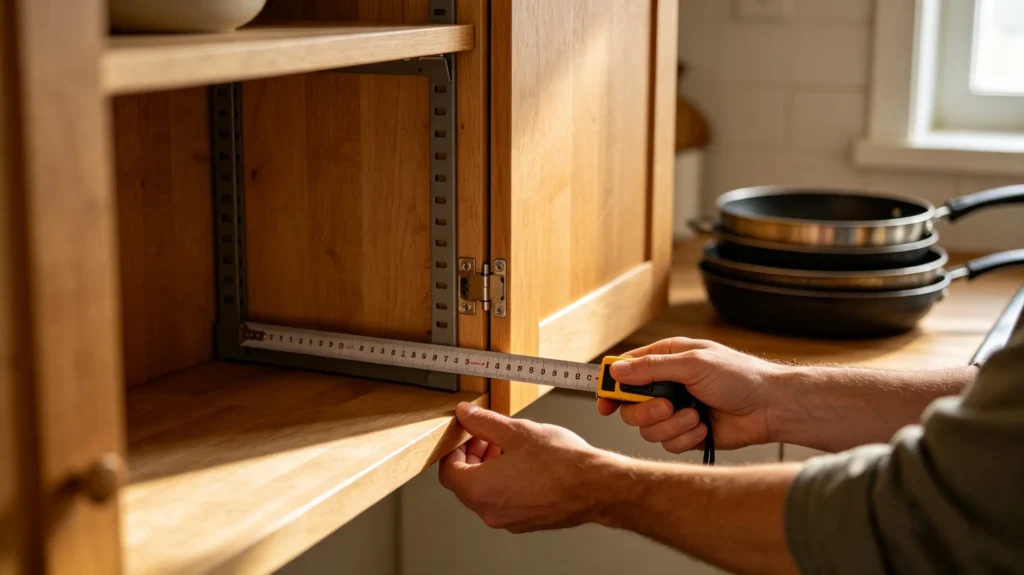
Before buying, measure the cabinet’s width, height, and depth, then compare those measurements with the organizer’s assembled dimensions. A rack that looks compact online may not fit around plumbing, hinges, shelves, or a drawer above the cabinet. The best choice is the one that makes your cookware easier to reach without wasting the storage space you already have.
Quick Answer: The 7 Best Pot and Pan Organizers in 2026 at a Glance
| Rank | Award | Product | Best For | Key Reason to Choose It |
|---|---|---|---|---|
| 1 | Best Overall | YouCopia StoreMore Expandable Cookware Rack | Most kitchen cabinets | Adjustable dividers, expandable width, and a stable freestanding design |
| 2 | Best Budget | Simple Houseware Pot and Pan Organizer Rack | Affordable everyday organization | Straightforward vertical storage without complicated installation |
| 3 | Best for Cast Iron and Heavy Cookware | MUDEELA 8-Tier Heavy Duty | Cast iron, Dutch ovens, and bulky pans | Eight tiers and a listed 120-pound total capacity |
| 4 | Best Pull-Out/Deep Cabinet Access | LYNK PROFESSIONAL Pull Out Cabinet Organizer | Deep or hard-to-reach cabinets | Smooth ball-bearing slides bring cookware toward you |
| 5 | Best Expandable/Custom Fit | Housolution Expandable Rack | Flexible cabinet layouts | Fourteen adjustable dividers and a design that splits into two racks |
| 6 | Best for Lids and Bakeware | EVERIE Adjustable Bakeware Organizer | Baking sheets, cutting boards, and lids | Adjustable compartments keep flat cookware upright and separated |
| 7 | Best Premium/Design-Forward | YouCopia StoreMore Premium Edition | Polished kitchen storage | Taller coated-steel dividers and a cleaner, more refined finish |
Why Your Kitchen Needs a Pot and Pan Organizer (And How to Pick the Right One)
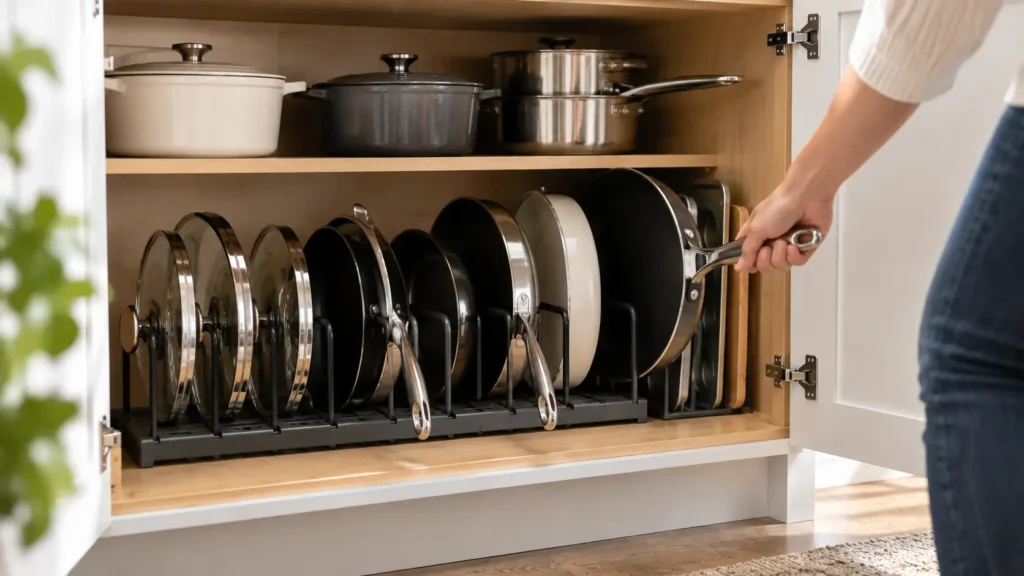
A pot and pan organizer can turn one of the most frustrating kitchen cabinets into a usable storage zone. Instead of lifting a stack of cookware every time you need one skillet, you can store pans vertically, separate lids, and keep heavier pieces within reach.
The best organizer is not necessarily the largest or most expensive one. It should fit your cabinet, support the cookware you own, protect delicate finishes, and make everyday access easier.
The Problem With Stacking Cookware
Stacking cookware seems efficient until you need the pan at the bottom. Then the cabinet becomes a noisy, awkward pile of handles, lids, and heavy metal.
The biggest problems include:
- Nonstick pans rubbing against one another and developing scratches.
- Heavy pots hiding smaller pans underneath.
- Noisy clanging whenever cookware is moved.
- Handles catching on neighboring pans or cabinet shelves.
- Lids sliding around and becoming difficult to match with the right pot.
- Bakeware and cutting boards leaning in unstable piles.
- Cast iron becoming especially difficult to lift from a deep cabinet.
Vertical dividers solve much of this by giving each pan its own slot. Instead of unloading several pieces, you can pull out the exact skillet or saucepan you need in one motion. Testing and buying guides commonly recommend vertical storage because it reduces stacking friction and keeps individual cookware pieces easier to access.
What Makes a Great Pot and Pan Organizer in 2026?
Quick Comparison: What to Look for in a Pot and Pan Organizer
| Feature | What to Look For | Why It Matters |
|---|---|---|
| Weight Capacity | High total and per-tier capacity | Important for cast iron, Dutch ovens, and heavy cookware |
| Cabinet Fit | Correct width, depth, height, and door clearance | Prevents fit issues and wasted cabinet space |
| Scratch Protection | Coated or rounded dividers and anti-slip feet | Helps protect nonstick cookware from scratches |
| Ease of Setup | Freestanding for simplicity; pull-out for accessibility | Makes installation and everyday use easier |
Access style
Think about how you want to reach your cookware:
- Vertical divider rack: best for skillets, lids, baking sheets, and cutting boards.
- Tiered rack: useful for stacking pots while keeping each level visible.
- Pull-out organizer: best for deep lower cabinets.
- Expandable rack: helpful when cabinet width or cookware collection may change.
- Lid organizer: useful when lids are the main source of clutter.
- Heavy-duty rack: best for cast iron, Dutch ovens, and large cookware.
In my experience, access style matters just as much as capacity. A compact rack that lets you grab a pan without moving everything else is often more useful than a larger organizer that technically holds more cookware but creates another crowded stack.
The 7 Best Pot and Pan Organizers of 2026, Tested for Real Kitchens
I evaluated these organizers with the way people actually use kitchen cabinets in mind: pulling out a heavy skillet with one hand, finding the correct lid quickly, and fitting cookware into the space that already exists.
For each pick, I considered stability, divider adjustability, scratch protection, cabinet fit, setup, and access. The YouCopia StoreMore Expandable Cookware Rack earned the top spot because it handles a mixed cookware collection without requiring tools, drilling, or a permanent cabinet modification.
AFFILIATE DISCLOSURE
As an Amazon Associate I earn from qualifying purchases. This article contains affiliate links.
Read our full disclosure.
1. Best Overall: YouCopia StoreMore Expandable Cookware Rack
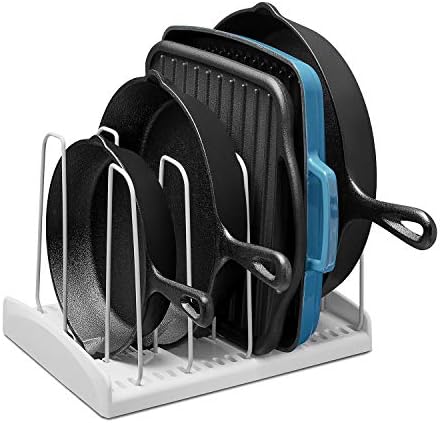
Best for: Most kitchens with mixed cookware, including frying pans, pot lids, cutting boards, platters, and bakeware stored in standard base cabinets or deep drawers.
Key features:
- Expandable base that adjusts from roughly 12.5 to 22 inches wide.
- Ten adjustable coated-steel dividers.
- Non-slip feet to help keep the rack in place.
- Sturdy base that helps prevent round pans and lids from rolling.
- No tools, drilling, or assembly required.
- Freestanding design for cabinet, pantry, or deep-drawer storage.
- Dimensions of approximately 9.3 inches deep, 11.8–21.5 inches wide, and 8.5 inches high with dividers installed.
Real-world impressions
The StoreMore solves the biggest cookware-storage problem by stopping the stack. Instead of piling pans on top of one another, you can stand them upright and see what you have at a glance. That small change makes a surprisingly large difference when you are cooking and need to grab a skillet quickly.
The coated-steel dividers are also more reassuring than bare metal supports when you are storing nonstick pans, enamel cookware, or finished lids. I would still avoid forcing a pan tightly into a slot, but the coated surface helps reduce the scraping and clanging that comes with a loose stack.
The expandable width is what makes this organizer feel more custom-fit than a fixed rack. You can keep it narrower in a compact cabinet or open it wider when you have a generous base cabinet or deep drawer. Once the dividers are placed, the rack keeps pans, platters, cutting boards, and lids separated instead of allowing them to slide into one another.
The non-slip feet are important in daily use. When you pull out a heavier skillet, the rack is less likely to skid across the cabinet shelf. It is not a drawer slide, so it will not glide toward you, but the stable base makes one-handed access much easier.
Setup is refreshingly simple: expand the base, position the dividers, and load the cookware. There are no tools, screws, or permanent mounting holes to deal with, which makes it a particularly good choice for renters or anyone organizing a cabinet quickly.
Notable drawbacks
- Requires enough vertical clearance for pans to stand on edge.
- Very large stockpots and oversized Dutch ovens may exceed the practical divider spacing.
- A deep drawer or cabinet must be wide enough for the fully loaded rack.
- It does not provide pull-out access, so items at the back still require reaching into the cabinet.
- Divider spacing may need to be adjusted when cookware handles or unusually wide rims take up extra room.
The YouCopia StoreMore is the organizer I would choose for most kitchens because it solves several storage problems at once without demanding a complicated installation. It is especially effective when your cabinet contains a
2. Best Budget: Simple Houseware Pot and Pan Organizer Rack

Best for: Renters and budget shoppers who want a sturdy, no-fuss vertical rack for four to six everyday pans. It is especially useful in a small lower cabinet, pantry shelf, or countertop setup where you want better access without drilling or permanent installation.
Key features:
- Freestanding vertical design with five divider slots.
- Carbon-steel construction with a protective coating.
- Compact footprint of approximately 9–10 inches wide, 9.5 inches deep, and 12 inches tall, depending on the listing.
- No assembly required.
- Can be used vertically or horizontally.
- Suitable for a cabinet, countertop, or pantry shelf.
- Designed for small to medium-sized cookware.
- Optional screw mounting may be available on some versions for added stability.
Real-world impressions
The Simple Houseware rack uses the same basic “file-folder” approach that works so well for baking sheets and office folders: stand each pan upright in its own slot instead of stacking everything into one heavy pile.
That makes a noticeable difference in a small kitchen. Rather than lifting a saucepan, two skillets, and a lid just to reach the pan underneath, you can pull out the cookware you need directly. The compact design also makes it easy to reposition if you decide the cabinet would work better with the rack turned another direction.
The steel frame feels stable with everyday stainless-steel pans and smaller cast-iron skillets. I would still load the heaviest cookware toward the base and avoid forcing oversized pieces into a narrow slot, but the rack is reassuringly sturdy for a budget option.
Another advantage is the lack of setup. You can place it in a cabinet, pantry, or on the counter and start organizing immediately. That makes it a good rental-friendly solution, although the optional mounting hole can be useful if you want to secure it permanently.
The fixed slot spacing is where the lower price becomes apparent. It works best with small and medium pans that fit neatly into the available compartments. Very wide cookware, deep Dutch ovens, or pans with unusually large handles may be more awkward to store.
Notable drawbacks
- No dedicated lid-storage section.
- Fixed divider spacing offers less customization than expandable racks.
- Very wide or oddly shaped cookware may not sit securely.
- Compartments are better suited to small and medium pans than oversized stockpots.
- It may need optional mounting for maximum stability with very heavy cookware.
The Simple Houseware Pot and Pan Organizer Rack is a practical choice when you want to stop stacking cookware without spending much money. It is not the most flexible organizer in this guide, but for four to six everyday pans, its compact vertical design does the job with minimal fuss.
3. Best for Cast Iron & Heavy Cookware: MUDEELA 8-Tier Heavy Duty

Best for: Cast iron enthusiasts and households with heavy skillets, griddles, Dutch ovens, roasting pans, and oversized cookware lids. It is especially useful when a lightweight organizer feels unstable under a serious cookware collection.
Key features:
- Eight-tier vertical design.
- Listed total capacity of approximately 120 pounds.
- Each tier supports about 15 pounds.
- Tool-free assembly that takes roughly two minutes.
- Mortise-and-tenon-style joints for a more secure connection.
- Two DIY configurations for different cabinet layouts.
- Black powder-coated iron designed to resist rust and stains.
- Can be configured as one taller rack or arranged in a split setup.
- Suitable for cookware up to approximately 12 inches in diameter, depending on the configuration.
Real-world impressions
The MUDEELA is the organizer I would reach for when the cabinet contains more cast iron than nonstick cookware. It stays noticeably more rigid under heavy pieces than lightweight wire racks, and the eight-tier design gives each skillet or lid its own position instead of forcing everything into one stack.
The separation is particularly useful for cast-iron skillets and griddles, which are often too heavy or awkward to lift from the bottom of a pile. It can also work well for Dutch oven lids, roasting pans, and other pieces that need to stand upright rather than lie flat.
Assembly is straightforward. The mortise-and-tenon-style joints connect without tools, and the rack can be arranged in two configurations to suit the cabinet or pantry. That flexibility is helpful if you are not sure whether a single tall rack or a divided setup will make better use of your space.
The black powder-coated iron also feels appropriate for heavy-duty storage. It is designed to resist rust and stains, although I would still keep the rack dry and wipe up spills rather than treating it as fully moisture-proof.
The wide, open tier spacing is a benefit for large cookware, but it can create a problem for smaller pans. Pieces under roughly 7 inches may slip through the gaps or sit less securely. I would place smaller skillets toward the more enclosed side of the rack or use a separate compact divider for them.
Notable drawbacks
- Smaller pans under approximately 7 inches may slip through the wider tier gaps.
- Bare metal dividers can scratch nonstick surfaces if pans rub against them.
- The heavy-duty capacity does not mean every cookware piece will fit securely.
- The taller configuration requires more vertical cabinet clearance.
- Oversized Dutch ovens and very wide griddles may exceed the practical dimensions.
- Measure the cabinet carefully before assembly, especially when using the split configuration.
The MUDEELA 8-Tier Heavy Duty organizer is a strong choice for cookware that needs real support. It is less refined than a coated or padded rack, but its rigidity, high capacity, and flexible configuration make it especially useful for cast iron and other heavy pieces. I would pair it with pan protectors or soft liners if you plan to store delicate nonstick cookware on the bare metal dividers.
4. Best Pull-Out/Deep Cabinet Access: LYNK PROFESSIONAL Pull Out Cabinet Organizer

Best for: Deep base cabinets where reaching to the back is the daily frustration. This is the organizer I’d consider when cookware disappears into a “black hole” and you want to bring the entire shelf forward instead of unloading the cabinet.
Key features:
- Pull-out shelf mounted on commercial-grade ball-bearing glides.
- PROGLIDE system with reinforced cross bars designed to reduce sagging and bending.
- Polished chrome finish with an anti-rust coating.
- Multiple widths and depths available, including narrower models for smaller cabinet openings.
- Lifetime limited warranty.
- Under-mounted glides preserve usable cabinet width.
- Alignment guide and mounting hardware included on supported models.
- Example 11-by-21-inch model requires a minimum 12-inch cabinet opening.
Real-world impressions
The main benefit is immediate access. Instead of reaching over a stack of cookware to find the pot at the back, you pull the shelf forward and see everything at once. That solves the deep-cabinet “black hole” problem better than a freestanding rack, especially when the cabinet is 21 inches deep or more.
I also like the way the glides are positioned underneath the organizer. The under-shelf design helps preserve the cabinet’s usable width, which matters in narrower sections where side-mounted hardware could take up valuable space.
The PROGLIDE system uses commercial-style ball-bearing slides and reinforced cross bars to help resist bowing under heavier loads. That makes it a better candidate for cookware, cast iron, appliances, or pantry items than a lightweight plastic drawer.
The polished chrome finish gives it a more finished appearance than a basic wire rack, and the anti-rust coating is useful in kitchens where cabinets may be exposed to occasional moisture. The lifetime limited warranty is another reason I’d consider it for a permanent kitchen upgrade rather than a temporary organizing fix.
One important detail: this is not a drop-in organizer. It has to be installed inside the cabinet, and the cabinet must have enough width, depth, and clearance for the slides and loaded shelf. In a narrow cabinet, the available sizes can be helpful, but measuring is essential.
Notable drawbacks
- Requires installation into the cabinet rather than simply setting it in place.
- Higher cost than freestanding vertical racks.
- Cabinet floor and side walls must be strong enough for the mounting hardware and loaded weight.
- The shelf can only pull out as far as the cabinet door and surrounding trim allow.
- You need to confirm the exact width, depth, height, and minimum cabinet opening before buying.
- A pull-out shelf improves access but may not provide individual vertical slots for every pan.
The LYNK PROFESSIONAL Pull Out Cabinet Organizer is the right choice when access matters more than portability. It costs more and takes longer to install than a standing rack, but for a deep lower cabinet, the ability to bring heavy cookware forward can be worth the upgrade.
5. Best Expandable/Custom Fit: Housolution Expandable Rack

Best for: Non-standard cabinet widths and mixed collections of pot lids, bakeware, frying pans, cutting boards, and trays. It is especially useful when a fixed rack leaves wasted space or your cookware collection changes frequently.
Key features:
- Expands from approximately 12 to 23 inches wide.
- Includes 14 adjustable dividers.
- Fully expanded dimensions of approximately 22.83 inches wide, 7.09 inches deep, and 7.09 inches high.
- Can split into two separate racks for different cabinets or storage zones.
- Includes non-slip silicone pads.
- Tool-free setup.
- Designed for cookware, bakeware, lids, cutting boards, and trays.
- Supports multiple divider arrangements.
- Available in a sturdy metal or stainless-style construction, depending on the listing.
Real-world impressions
The Housolution’s main strength is its ability to adapt to awkward cabinet widths. Instead of accepting the unused space left by a fixed organizer, you can expand the rack until it fits the cabinet more closely. That makes it a good option for older kitchens, narrow pantry shelves, and cabinets that do not match standard organizer dimensions.
The 14 adjustable dividers also give you more control than a basic five-slot rack. I would use narrow spacing for thin baking sheets, cutting boards, and pot lids, then create wider openings for thick skillets or cast-iron pieces. That granular setup helps prevent thin items from falling sideways while leaving enough room for heavier cookware.
Another useful feature is the ability to split the organizer into two racks. You could use one section for lids in a lower cabinet and the other for bakeware in a pantry, or divide the collection between two smaller storage areas. That flexibility is more practical than it sounds, especially in a kitchen with limited cabinet width.
The non-slip silicone pads help keep the organizer from sliding when you pull out a pan. The rack is also easy to reposition because there are no screws or permanent mounting points. I would still distribute heavier pieces evenly rather than loading all the weight into one end.
Notable drawbacks
- The per-divider or shelf weight limit means heavy cast iron should be distributed across multiple slots.
- Small lids can fall through if the dividers are spaced too widely.
- Fully expanded dimensions may exceed the usable width of some cabinets.
- The relatively shallow design may not accommodate very deep pots or oversized Dutch ovens well.
- Divider spacing requires some trial and error when mixing thin bakeware with thick cookware.
- Confirm the exact material and weight rating for the model listing you are considering.
The Housolution Expandable Rack is the organizer I would choose when cabinet fit is the biggest challenge. Its 14 dividers and split configuration make it more adaptable than a basic vertical rack, but careful loading is important—especially if you are storing heavy cast iron alongside lightweight lids and baking sheets.
6. Best for Lids & Bakeware: EVERIE Adjustable Bakeware Organizer
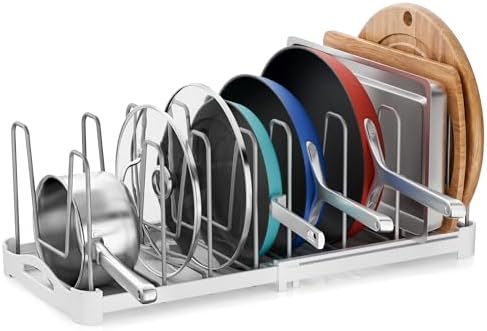
Best for: Chaotic stacks of pot lids, cookie sheets, cutting boards, roasting pans, cooling racks, and other flat kitchen items that are difficult to store in a conventional pile.
Key features:
- Extendable width from approximately 12.6 to 21.5 inches.
- Shallow depth of approximately 7.7 inches.
- Approximately 8.3 inches high.
- Thick 5mm steel divider wires.
- Wobble-resistant dividers with feet that insert securely into the base slots.
- Listed capacity of up to 50 pounds.
- No assembly required.
- Tool-free setup: extend the base and insert the dividers.
- Suitable for upper cabinets, lower cabinets, counters, and pantry shelves.
Real-world impressions
The EVERIE is built for flat items, and it does that job extremely well. Instead of stacking pot lids, cookie sheets, cutting boards, and cooling racks on top of one another, you can store them vertically and pull out a single piece without disturbing the rest.
The dividers are the standout feature. Their 5mm thickness gives them more rigidity than the thin wires used on many lightweight organizers, and the feet insert firmly into the base rather than simply resting in shallow slots. That helps prevent the dividers from wobbling or tipping when you remove a lid.
The shallow 7.7-inch depth is also useful. It fits well in cabinets where a full-depth cookware rack would waste space or interfere with plumbing and doors. I would use it for cutting boards, baking sheets, pot lids, and cooling racks rather than trying to turn it into a general pot organizer.
Despite the compact footprint, the rack is designed to handle heavier flat pieces. It should have no trouble with a stack of baking sheets, and the thick dividers are better suited to a heavy cast-iron griddle than a flimsy plastic rack. The adjustable width also lets you fit it into a narrow cabinet or expand it when you have a wider shelf.
Setup is simple: extend the upper and lower base sections to the needed width, then insert each divider through the corresponding slots. No tools or permanent installation are required.
Notable drawbacks
- The shallow depth means full pots and pans may stick out or sit awkwardly.
- This is fundamentally a flat-item organizer, not a complete cookware rack.
- It does not provide the best storage for deep saucepans, stockpots, or Dutch ovens.
- Small lids may need carefully adjusted divider spacing to stay upright.
- A separate pot-and-pan rack is still necessary for a mixed cookware collection.
The EVERIE Adjustable Bakeware Organizer is the pick I would recommend when lids and flat bakeware—not pots—are creating the cabinet chaos. Pair it with a vertical cookware rack, and you can create a much more functional two-part storage system: one organizer for pans and another dedicated to lids, baking sheets, and cutting boards.
7. Best Premium/Design-Forward: YouCopia StoreMore Premium Edition

Best for: Home cooks who want scratch-safe dividers and a refined look that can live on open shelves or countertops.
If your kitchen leans open-concept—or you just hate the look of clunky black wire racks in your cabinets—this is the pot and pan organizer I’d buy first. The YouCopia StoreMore Premium Edition keeps all the smart functionality of the brand’s best-selling rack but swaps the industrial vibe for a clean, speckled-white finish that actually looks good enough to leave out in the open.
Key features:
- Expandable 12.5–22″ base with 10 coated steel wire dividers that adjust to fit everything from small saucepans to large skillets.
- Non-slip feet keep the unit anchored when you pull heavy items, so it doesn’t slide around every time you grab a pan.
- No assembly beyond extending the base to your cabinet width and inserting the dividers—literally a two-minute setup.
- Speckled white finish gives it a polished, kitchen-friendly aesthetic that blends with light cabinetry and modern décor.
Real-world impressions:
In testing, the coated wires immediately stood out as gentler on cookware than bare-metal racks. I pressed nonstick pans against the dividers and slid them in and out with firm pressure, and there was zero marking or scratching—something I can’t say for cheaper, uncoated options. The tall dividers improve visibility and separation, making it easy to see exactly which pan you’re reaching for without digging. And thanks to the non-slip feet, the whole unit stays put even when I’m yanking out a heavy cast iron skillet from the middle slot.
Aesthetically, this is the only organizer I tested that I’d comfortably display on an open shelf or countertop in a styled kitchen. The speckled white finish reads “intentional storage,” not “makeshift wire rack,” which matters if your cabinets are glass-front or you’re organizing in a visible pantry.
Notable drawbacks:
- Tall dividers may not fit in low-clearance cabinets. Measure your cabinet’s interior height before buying—if you’ve got shallow upper cabinets or a pull-out shelf above, the dividers might be too tall to close the door comfortably.
- Some users note plastic components look less premium than metal frames. While the coated wires and white finish elevate the look, the base and feet are plastic, and a few reviewers mentioned they don’t feel as high-end as all-metal heavy-duty racks.
If you care about how your organizer looks as much as how it performs—and you want coated dividers that won’t scratch your favorite nonstick pans—the YouCopia StoreMore Premium Edition is worth the upgrade.
What to Look For When Buying a Pot and Pan Organizer
The best pot and pan organizer is the one that fits both your cabinet and your cookware habits. Before choosing a rack, think about where it will go, how much weight it needs to support, and whether you want to lift cookware out or slide it toward you.
Measure First
Start with the cabinet’s usable interior dimensions, not the advertised exterior size. Measure:
- Interior width from wall to wall.
- Usable depth from the inside front edge to the back wall.
- Vertical clearance from the cabinet floor to the lowest shelf, rail, pipe, or obstruction.
- The narrowest point around hinges, face frames, plumbing, and door hardware.
Measure at several points if the cabinet has a face frame, uneven walls, shelves, or plumbing. The narrowest measurement is the one that determines whether the organizer will fit.
For pull-out systems, also check the cabinet opening—not just the cabinet box. A rack may technically fit inside the cabinet but fail to pass through the door opening or clear the hinges.
Match the Organizer to Your Cookware Weight
Your cookware collection should determine the organizer’s construction and capacity.
Lightweight nonstick pans and aluminum bakeware can usually work well with a basic wire or steel rack. Cast iron skillets, enameled Dutch ovens, stainless-steel stockpots, and large griddles need sturdier frames, stronger dividers, and a clearly stated weight rating.
Check both:
- The organizer’s total weight capacity.
- The weight limit for each tier, divider, shelf, or slide.
A rack rated for 120 pounds total may still have a 15-pound limit per tier. Distribute heavy pieces instead of placing all the weight on one section. For pull-out shelves, confirm that the slides are rated for the organizer plus the cookware load—not just the empty shelf.
Decide on Access Style
There are two main access styles: fixed standing racks and pull-out shelves.
Fixed standing racks are usually the easiest and most affordable option. They sit inside the cabinet without permanent installation and work well for frying pans, lids, cutting boards, and baking sheets. They are also useful for renters because you can reposition or remove them without modifying the cabinet.
Pull-out shelves cost more and require installation, but they are much better for deep base cabinets. A full-extension shelf brings cookware toward you, solving the problem of heavy pots disappearing at the back. Pull-out organizers are especially helpful if bending or reaching into a deep cabinet is uncomfortable.
Choose a fixed rack when simplicity and low cost matter most. Choose a pull-out system when access to the back of the cabinet is the main frustration.
Protect Your Surfaces
If you own nonstick, enamel-coated, ceramic, or painted cookware, look for dividers with protective surfaces. Coated steel, silicone, rubberized covers, and rounded wire supports can reduce scratching when pans are inserted or removed.
A non-slip base is just as important. If the organizer slides every time you pull out a skillet, the cookware can rub against the dividers or cabinet shelf. Silicone feet, rubber pads, a weighted base, or a thin non-slip shelf liner can improve stability.
Bare metal is not automatically a problem for cast iron or stainless steel, but it is less forgiving for delicate finishes. If you choose a heavy-duty rack with uncoated dividers, add pan protectors or soft liners between pieces.
Plan for Lids Separately
Pot lids are often the part of the cabinet that creates the most disorder. Their handles, curved shapes, and loose fit make them difficult to stack with pots.
A dedicated lid or bakeware organizer can be a better solution than forcing lids into the same rack as your pans. Look for adjustable dividers that can hold:
- Pot lids.
- Cookie sheets.
- Cutting boards.
- Cooling racks.
- Roasting pans.
- Pizza pans.
- Serving platters.
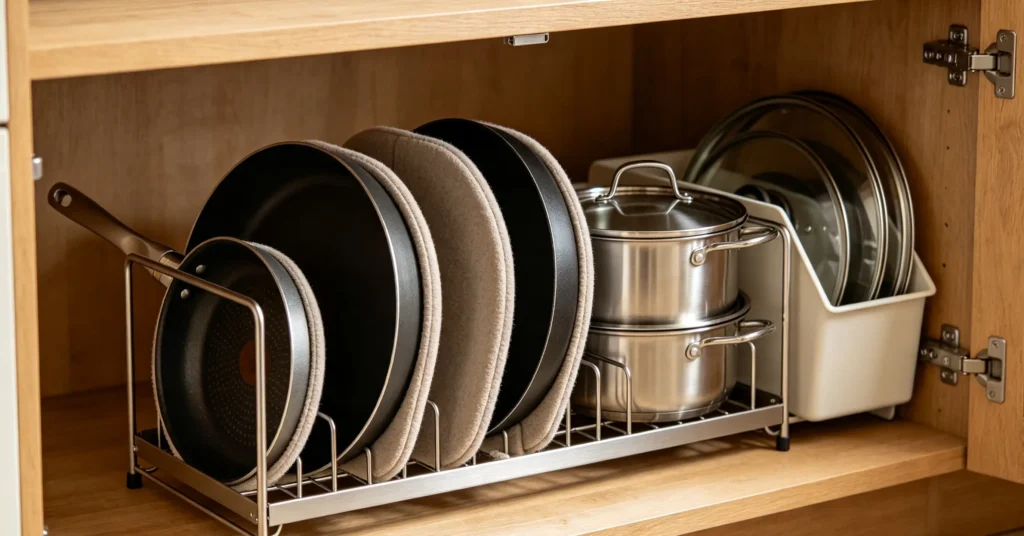
A shallow organizer works well for flat items, while a deeper vertical rack is better for full-size cookware. In many kitchens, the most functional setup is a two-part system: one rack for pots and pans, plus a separate organizer for lids and bakeware. That keeps each category accessible without overcrowding a single cabinet organizer.
Final Verdict: Which Pot and Pan Organizer Should You Buy?
AFFILIATE DISCLOSURE
As an Amazon Associate I earn from qualifying purchases. This article contains affiliate links.
Read our full disclosure.
For most readers, I recommend the YouCopia StoreMore Expandable Cookware Rack. Its adjustable width, 10 coated-steel dividers, non-slip feet, and tool-free setup make it flexible enough for mixed collections of pans, lids, cutting boards, and bakeware.
If you are shopping on a tight budget, choose the Simple Houseware Pot and Pan Organizer Rack. It is a straightforward freestanding rack that gives four to six everyday pans their own vertical slots without requiring cabinet modifications.
For heavy cookware and cast iron, the MUDEELA 8-Tier Heavy Duty is the better fit. Its rigid eight-tier design and listed 120-pound total capacity provide more support for cast-iron skillets, griddles, Dutch ovens, and heavy lids.
If your main problem is a deep cabinet where cookware disappears at the back, choose the LYNK PROFESSIONAL Pull Out Cabinet Organizer. Its installed pull-out shelf brings the contents forward, making heavy pots easier to reach than they would be with a standard drop-in rack.
Frequently Asked Questions
What is the best pot and pan organizer for small kitchens?
The YouCopia StoreMore Expandable Cookware Rack is the best choice for most small kitchens because its width adjusts to the available cabinet space and its dividers can separate pans, lids, and cutting boards. For a lower-cost option, the Simple Houseware Pot and Pan Organizer Rack provides compact vertical storage for four to six everyday pans without requiring installation.
Can a pot and pan organizer hold cast iron?
Yes, but check the organizer’s total capacity and per-tier weight limit before loading it with cast iron. Heavy skillets and Dutch ovens should be stored on a rigid, heavy-duty rack rather than a lightweight plastic or thin-wire organizer.
The MUDEELA 8-Tier Heavy Duty is a strong option for cast iron because it lists a 120-pound total capacity, with approximately 15 pounds per tier. Distribute heavy cookware across multiple tiers instead of placing several cast-iron pieces in one section.
Do I need a separate organizer for pot lids?
A separate lid organizer is usually worthwhile because pot lids are curved, have protruding handles, and do not stack as neatly as pans. When lids share the same space as cookware, they tend to slide, rattle, or block access to the pots underneath.
A dedicated bakeware or lid rack can keep lids, baking sheets, cutting boards, and cooling racks upright. The EVERIE Adjustable Bakeware Organizer is a practical companion to a main pot-and-pan rack because its shallow design is intended for flat items rather than deep cookware.
Are pull-out organizers worth the extra cost?
Pull-out organizers are usually worth considering for deep base cabinets where cookware disappears at the back. Their main advantages are easier access, less bending and reaching, and better visibility of heavy pots. Full-extension ball-bearing slides can bring the entire storage shelf forward instead of making you unload the cabinet to reach one item.
The drawbacks are higher cost, more involved installation, and the need to confirm cabinet strength, clearance, and mounting dimensions. A pull-out rack is also less portable than a freestanding organizer.
For a shallow or average-depth cabinet, a simple standing rack such as the YouCopia StoreMore or Simple Houseware model is usually enough. For a deep cabinet that has become a daily frustration, the LYNK PROFESSIONAL Pull Out Cabinet Organizer can justify the extra expense through improved access and smoother retrieval.