
AFFILIATE DISCLOSURE
As an Amazon Associate I earn from qualifying purchases. This article contains affiliate links.
Read our full disclosure.
Turn Wasted Gaps Into Useful Storage With the Right Rolling Cart
That narrow gap beside the refrigerator, washing machine, bathroom vanity, or desk is easy to ignore—but it can become some of the most useful storage in your home. The right slim rolling cart turns otherwise wasted space into a mobile spot for spices, toiletries, cleaning supplies, craft materials, pantry staples, or office essentials.
I looked at current product listings and manufacturer specifications with the same questions I would use when shopping for my own home: How much floor space does the cart really occupy? Are the shelves practical for everyday items? Do the casters roll smoothly and lock securely? And can the frame handle the kind of weight you actually plan to store?
This guide compares seven carts for different rooms and shopping priorities. The recommendations consider dimensions, materials, shelf layouts, caster design, load capacity, maintenance, price, and real-world usability—not just how many tiers appear in the product photos. A cart that works beautifully beside a kitchen counter may be too wide for a laundry gap, while a six-tier organizer may offer excellent vertical storage but less stability when heavily loaded.
My overall pick is the SPACEKEEPER Slim 3-Tier Rolling Cart because it combines a narrow profile with accessible shelves and flexible storage. However, the smaller IKEA RÅSKOG is a better budget choice for bedrooms and desks, while taller six- and seven-tier carts make more sense when your main goal is maximum storage in a very narrow footprint.
The key is to choose based on the space you have and the items you need to store. Before ordering, measure the complete route—not just the gap where the cart will sit—and check the cart’s full assembled dimensions, including wheels, handles, and side hooks.
Quick Picks
After comparing the carts by footprint, shelf design, materials, caster setup, capacity, and everyday versatility, these are the models I would shortlist first. I included the important measurements below, but always check the retailer’s current listing before ordering—especially for carts with multiple sizes or color options.
| Category | Recommended cart | Why it stands out |
|---|---|---|
| Best overall | SPACEKEEPER Slim 3-Tier Rolling Storage Cart | Extremely narrow footprint with mobile, adjustable storage for kitchens, bathrooms, laundry rooms, and offices |
| Best budget | IKEA RÅSKOG Small Utility Cart | Compact metal design with lockable casters for bedrooms, dorms, desks, and bathrooms |
| Best for maximum vertical storage | 6-Tier Slim Metal Rolling Cart | Uses vertical space efficiently for spices, toiletries, cleaning products, and small pantry items |
| Best for kitchens | IKEA RÅSKOG Utility Cart | Larger shelves and strong load capacity for cooking tools, coffee supplies, produce, and pantry overflow |
| Best for bathrooms | Pipishell 3 Tier Bathroom Storage Cart | Shallow profile fits beside vanities, toilets, and laundry hampers without taking over the walkway |
| Best for larger households | 7-Tier Slim Rolling Storage Cart | Separates many small items while using very little floor space in pantries, laundry rooms, and utility areas |
| Best for desks and craft rooms | IKEA RÅSKOG/NORRÅVA Cart With Lid | Combines mobile shelving with a useful flat top for notebooks, tablets, craft tools, or drinks |
The 7 Best Slim Rolling Carts
AFFILIATE DISCLOSURE
As an Amazon Associate I earn from qualifying purchases. This article contains affiliate links.
Read our full disclosure.
1. SPACEKEEPER Slim 3-Tier Rolling Cart

Best for: Kitchens, bathrooms, laundry rooms, and narrow gaps measuring roughly 9 inches wide.
Why It Stands Out
The SPACEKEEPER is my pick for the best overall slim rolling cart because it solves the main problem these organizers are meant to address: turning a nearly unusable gap into accessible storage. Its narrow frame takes up very little floor space, while three open tiers provide enough room for everyday household supplies.
I also like how mobile it is. Instead of reaching awkwardly behind an appliance or digging through a crowded cabinet, you can pull the cart toward you, grab what you need, and roll it back into place. Depending on the version, the cart measures approximately 5.1 inches wide, although some listings show larger configurations, so checking the exact model dimensions is important.
The design is versatile enough for several rooms. It can work as a laundry-supply organizer, a bathroom toiletries cart, a kitchen pantry extender, or a compact office shelf.
Key Features:
- Three adjustable shelf configurations.
- Slim design advertised in versions around 5.1 to 8.66 inches wide.
- Plastic shelves supported by a stainless-steel or steel frame.
- Four rolling casters for moving the cart in and out of tight spaces.
- Four side hoops or removable hanging accessories for brushes, cloths, and small tools.
- Convertible setup that can accommodate fewer shelves in some configurations.
- Some versions include wheels with brakes for keeping the cart stationary.
The open basket-style shelves are particularly practical because they help keep smaller items from sliding off as you move the cart. Some listings also describe smooth-gliding casters and side hooks for extra hanging storage.
Real-World Use
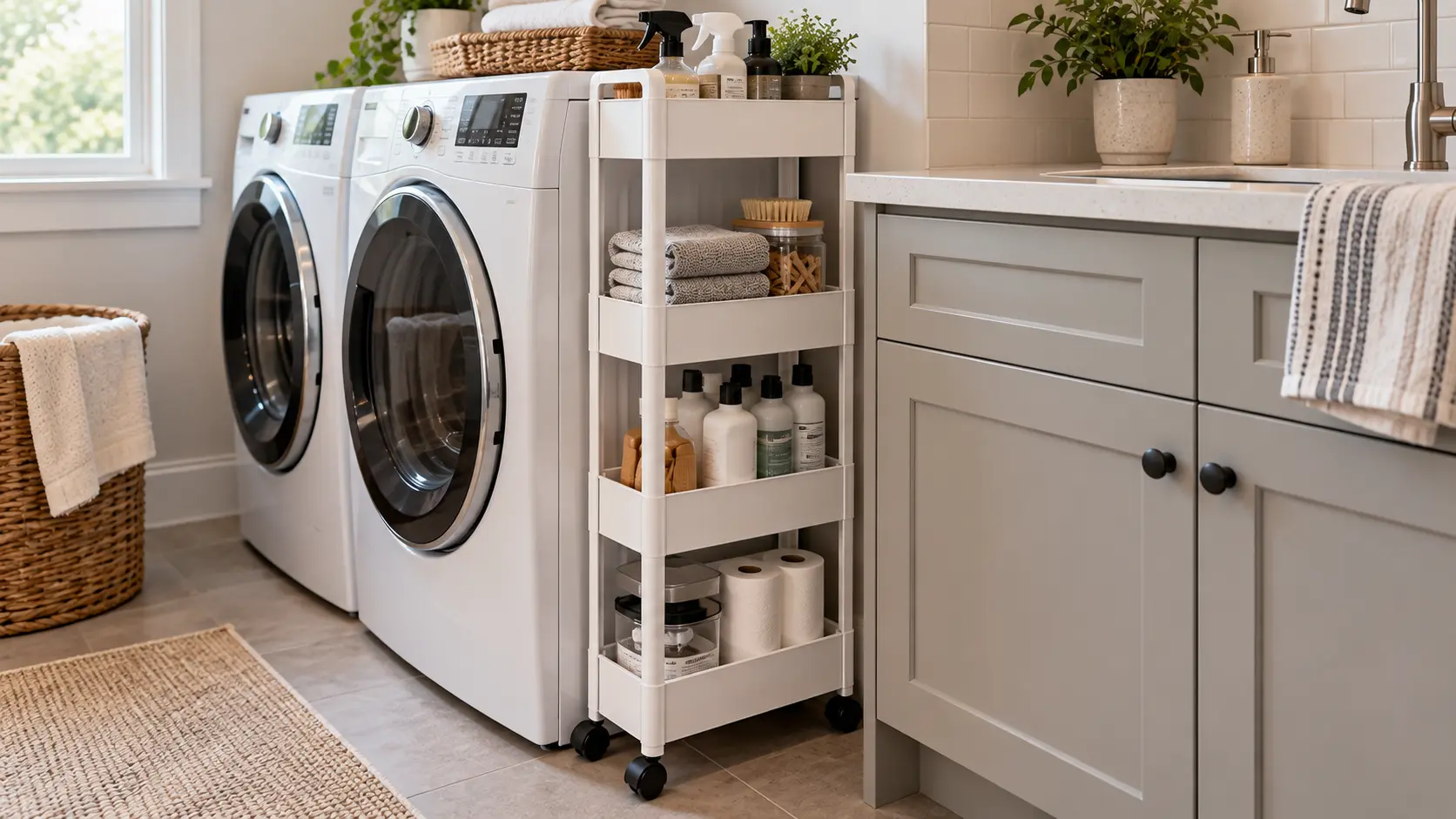
In a laundry room, I would place the SPACEKEEPER between the washer and a cabinet, using the bottom shelf for detergent and stain remover, the middle shelf for dryer sheets and cleaning cloths, and the top shelf for smaller supplies.
Beside a bathroom vanity, it can hold toiletries, hair products, toilet-cleaning supplies, brushes, and backup towels. The side hoops are useful for items that are awkward to place on a shelf, such as microfiber cloths, small brushes, or spray-bottle accessories.
It also makes a practical kitchen organizer when cabinet space is limited. Use it for spices, condiments, snack packages, coffee supplies, or pantry items that tend to disappear behind larger containers. Because the cart rolls forward, you can see the back of each shelf without unloading everything in front.
That pull-out access is the biggest everyday advantage. A fixed narrow shelf may fit the gap, but a rolling cart makes the storage much easier to use.
Notable Drawbacks:
- Open shelves provide limited protection from dust, grease, moisture, and bathroom splashes.
- Plastic trays may feel less substantial than steel shelves.
- Package dimensions may not match the assembled cart dimensions.
- Some versions vary considerably in width, height, shelf count, and layout.
- Tall, narrow loading can make the cart feel unstable if heavy items are placed too high.
- Hooks and casters may extend beyond the listed shelf width.
I would not treat the narrow footprint as a reason to overload the cart. A slim organizer can hold a surprising amount, but its stability depends heavily on how the weight is distributed. Keep bulky bottles low, avoid stacking unstable containers, and check whether the cart rolls smoothly on your particular floor.
Best-Use Tip
Place detergent, canned goods, bottled products, and other dense items on the bottom shelf. Keep lighter toiletries, cloths, spices, and small accessories on the upper tiers to improve stability and make the cart easier to pull out.
Before buying, measure the entire opening—including baseboards, cabinet handles, wheels, and side hooks—not just the empty gap. The SPACEKEEPER is impressively narrow, but the correct version for your room is the one that fits with enough clearance to move freely.
2. IKEA RÅSKOG Small Utility Cart
Best for: Bedrooms, dorm rooms, desks, bathrooms, and shoppers seeking a compact metal cart at a low price.
Why It Stands Out
The smaller IKEA RÅSKOG is my budget-friendly pick for anyone who wants a sturdy, uncomplicated storage cart without spending much. IKEA lists it at $29.99, and its steel construction feels more substantial than the lightweight plastic carts commonly sold for narrow spaces.
This is not an ultra-narrow 5- or 6-inch organizer, so it will not slide into every appliance gap. Instead, it is a compact three-tier cart for spaces where you have a little more room but still want storage that can move. Its 11-by-15-inch footprint and 24-inch height make it particularly useful under or beside many desks and tables.
Key Features:
- Three steel storage tiers.
- Lockable casters.
- Four smooth-rolling wheels.
- 24-inch overall height.
- 9-pound load capacity per tier.
- 26-pound maximum total load.
- Approximate dimensions of 11 inches long by 15 inches wide by 24 inches high.
- Multiple color options.
- Listed price of $29.99 at the time of research.
- Epoxy powder-coated steel construction.
The mesh-style shelves are a practical touch. They allow air to circulate, make the contents easy to see, and help reduce dust buildup compared with enclosed, solid-sided storage. IKEA also notes that the smaller version is designed to fit beneath most tables and desks.
Real-World Use
Beside a desk, the RÅSKOG can hold chargers, notebooks, headphones, stationery, and small tech accessories. I like it for work-from-home setups because it keeps frequently used items close without taking up valuable desktop space. It can also roll out of the way when you need to vacuum or rearrange the room.
In a dorm room or bedroom, use the shelves for snacks, books, beauty products, or bedside essentials. The 24-inch height is less visually imposing than a taller pantry cart, so it works well next to a bed, dresser, or compact workstation.
The cart also makes sense in a bathroom. It can hold folded hand towels, hair products, backup toiletries, and everyday grooming supplies. The open steel shelves are easy to wipe clean, while the raised edges help keep bottles and small containers from sliding off when the cart is moved.
The lockable casters are useful once you find the right parking spot. Roll the cart beside your desk or vanity, lock the wheels, and the cart stays put while you reach for supplies. IKEA lists the cart as having four smooth-rolling casters and lockable wheels for stability when parked.
Notable Drawbacks:
- At 15 inches wide, it is too large for many very narrow appliance gaps.
- The smaller shelves hold less than those on the full-size RÅSKOG.
- A 9-pound per-tier limit makes it less suitable for heavy pantry goods or large bottles.
- The casters improve mobility but do not replace careful weight distribution.
- Open shelves leave items visible and offer little protection from splashes or dust.
- Assembly quality and included hardware may vary, so inspect the parts before putting it together.
The biggest limitation is simply scale. This cart is compact, but it is not a true slide-out pantry tower. If your available gap is only 6 or 8 inches wide, measure carefully before buying—or choose a purpose-built slim cart instead.
Best-Use Tip
Choose the smaller RÅSKOG when compact, general-purpose storage matters more than an ultra-slim footprint. Keep heavier items on the bottom tier, lighter supplies on top, and lock the casters whenever the cart is parked. For a desk, bedroom, dorm, or bathroom, it offers a sturdy and affordable way to keep everyday clutter organized without committing to a larger shelving unit.
3. 6-Tier Slim Metal Rolling Cart

Best for: Pantry ingredients, toiletries, cleaning products, and shoppers who need more shelves rather than wider shelves.
Why It Stands Out
When floor space is scarce, the easiest way to add storage is to build upward. A six-tier slim metal rolling cart does exactly that, using vertical space that would otherwise go unused beside a refrigerator, cabinet, washing machine, or bathroom vanity.
This is my pick for the best vertical-storage solution. Instead of trying to fit several categories onto two or three broad shelves, you get a separate level for each type of small item. Current listings include models advertised at approximately 6 inches wide, while some similar designs measure closer to 5.9 inches wide and more than 50 inches tall.
That height makes these carts surprisingly useful in narrow gaps, but it also means stability matters more than it does with a short utility cart. Think of this as a compact pull-out pantry for small containers—not a miniature shelving unit for heavy appliances or oversized storage bins.
Key Features:
- Six vertical storage tiers.
- Narrow metal frame.
- Rolling casters for repositioning.
- Small footprint for spaces beside appliances, cabinets, and vanities.
- Some versions include side hooks or hanging accessories.
- Retail listings advertise widths of approximately 6 inches.
- Some models include two lockable wheels for keeping the cart in position.
- Metal construction designed for kitchens, bathrooms, offices, laundry rooms, and utility areas.
The exact dimensions vary widely between models. One Target listing, for example, describes a steel-and-particleboard cart measuring approximately 5.9 inches wide, 17.9 inches deep, and 51.7 inches high. That is why I would treat “6-inch cart” as a starting point, not a complete measurement.
Real-World Use
The six-tier format works best for small items that are easy to lose in a deep cabinet. In a kitchen, I would use the shelves for spices, sauces, seasoning packets, tea, coffee supplies, and small pantry packages.
In a bathroom, the cart can separate skincare products, hair accessories, toiletries, washcloths, and backup supplies. The narrow shelves are useful for bottles and tubes, but you will want to check the shelf depth before buying if you plan to store large shampoo bottles or bulk packages.
It also makes a practical laundry-room organizer. Use one shelf for stain remover, another for dryer sheets, and the remaining levels for clothespins, laundry bags, cleaning cloths, or small tools. Side hooks, when included, can hold brushes or lightweight accessories without taking up shelf space.
A six-tier cart can also work beside a desk or craft station. Stationery, pens, cutting tools, rolls of tape, yarn, and small project supplies are much easier to sort when each category has its own level.
The main tradeoff is shelf size. These carts maximize the number of storage levels, but the shelves are often shallow. They are best for small containers and narrow packages rather than bulky products such as large detergent jugs, bags of rice, appliances, or wide baskets.
Notable Drawbacks:
- Tall, narrow designs may wobble when heavily loaded.
- Shallow shelves limit the size of containers you can store.
- Assembly may take longer than with a simple three-tier cart.
- The advertised width may not include handles, hooks, or wheel projections.
- Height can make the cart difficult to use beneath cabinets or low shelves.
- Some models vary significantly in depth, shelf spacing, and caster design.
- A narrow metal frame may not be suitable for very heavy loads.
The width deserves special attention. A cart advertised as 6 inches wide may have a handle, wheel hardware, or side hook that extends beyond the main shelf frame. Measure the complete assembled width, then leave a little clearance so the cart does not scrape against the appliance or cabinet.
I would also avoid placing a tall cart where children or pets can easily pull on it. Wheel locks can keep it parked, but they do not eliminate the risk of tipping if the cart is overloaded or pulled sideways.
Best-Use Tip
Keep the heaviest items on the bottom shelf and reserve the upper tiers for lightweight products. Avoid placing breakable glass containers, large liquid bottles, or unstable items at the top.
Before ordering, measure the gap at the floor, middle, and top. Baseboards, cabinet trim, appliance edges, and uneven walls can make the opening narrower in one spot than another. Then check the complete pull-out path so the cart clears doors, handles, rugs, and nearby countertops.
4. IKEA RÅSKOG Utility Cart

Best for: Food prep, coffee stations, baking supplies, cooking tools, and small kitchens.
Why It Stands Out
The full-size IKEA RÅSKOG is better thought of as a mobile kitchen station than an ultra-slim gap cart. At approximately 13¾ inches long by 17¾ inches wide and 30⅜ inches high, it needs more floor space than a narrow pull-out organizer, but the larger shelves are far more useful for everyday kitchen items.
This is the cart I would choose when you want storage that can move between the counter, pantry, dining area, or coffee station. Its powder-coated steel frame feels sturdier than lightweight plastic alternatives, and IKEA lists a 40-pound maximum load with a 13-pound capacity per tier.
The U.S. listing showed a price of $39.99 at the time of research, and the cart is available in multiple colors.
Key Features:
- Three steel storage tiers.
- 40-pound maximum total load.
- 13-pound load rating per tier.
- Four smooth-rolling casters.
- Lockable wheels for added stability when parked.
- Approximately 30-inch working height.
- Multiple color options.
- Approximate dimensions of 13¾ inches long by 17¾ inches wide by 30⅜ inches high.
- Epoxy powder-coated steel construction.
- Mesh shelves that allow airflow and make contents easy to see.
The raised, mesh-style shelves are especially practical for bottles, jars, produce, and kitchen tools. They also make the cart easier to clean than a fabric organizer or a deep, enclosed cabinet. IKEA recommends wiping it clean with a damp cloth and mild detergent when needed.
Real-World Use
I would position the RÅSKOG between the kitchen counter and pantry when I need extra storage during meal preparation. The cart can move closer while cooking, then roll back against a wall or cabinet when the kitchen needs to be cleared.
Use the top shelf for the items you reach for most often, such as coffee supplies, cooking utensils, spices, produce, or baking tools. The middle shelf works well for bowls, pantry containers, mixing accessories, and packaged ingredients. Reserve the bottom shelf for heavier items such as bottled drinks, small appliances, or larger food-storage containers.
It also works well as a mobile coffee station. Keep coffee beans, filters, mugs, sweeteners, and a grinder on the top two levels, while the bottom tier holds extra supplies. The lockable wheels let you keep the cart steady while filling a kettle or reaching for a container.
For small kitchens, the RÅSKOG can provide useful overflow storage without requiring a permanent kitchen island. It can also move into the dining area when you need a serving cart or beside a baking station when preparing a larger recipe.
Notable Drawbacks:
- At 17¾ inches wide, it is too large for many narrow appliance gaps.
- Open shelves can collect crumbs, grease, and dust.
- There is no built-in flat work surface.
- The cart is more visible than an internal cabinet organizer.
- The open design leaves kitchen supplies on display.
- IKEA notes that the cart is for indoor use and is not approved for direct food contact.
The main limitation is the footprint. Although IKEA describes it as compact enough for tight spaces, it is not the right choice for a gap that is only 6, 7, or 8 inches wide. It needs room to roll and turn, so measure the surrounding cabinets, appliance handles, and walking path—not just the spot where you plan to park it.
Best-Use Tip
For genuinely tight kitchen gaps, choose a model advertised at 8 inches wide or less. Choose the full-size RÅSKOG when you have enough room for broader shelves and want a sturdy cart that can function as mobile storage, a coffee station, or a flexible prep-side organizer. Keep dense items on the bottom tier, lock the casters when parked, and avoid treating the open shelves as a substitute for a sealed pantry.
5. Pipishell 3-Tier Bathroom Storage Cart
Best for: Toiletries, toilet paper, towels, and bathroom storage beside a vanity or toilet.
Why It Stands Out
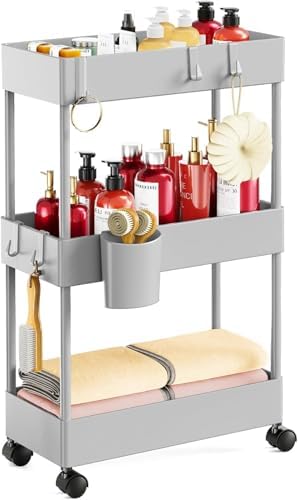
The Pipishell 3-Tier Bathroom Storage Cart is designed for bathrooms where every inch of floor space matters. Its shallow profile is easier to place beside a vanity, toilet, or laundry hamper without making the walkway feel cramped.
I would classify this as a cart for shallow spaces, rather than an ultra-narrow side-to-side organizer. A commonly listed version measures approximately 7.1 inches deep, 15.8 inches wide, and 26.4 inches high, so it does not necessarily fit a gap that is only a few inches wide.
That distinction is worth checking before you order. The cart may be shallow from front to back, but its overall width still requires enough clearance beside the fixture or furniture.
Key Features:
- Three open storage tiers.
- Approximately 7.1 to 7.2-inch depth, depending on the version.
- Approximately 26 to 29 inches high, depending on the listing.
- Lockable or braking caster design on selected versions.
- Approximately 15.8-inch width.
- Compact profile for bathroom corners and narrow walkways.
- Rolling construction for pulling supplies closer when needed.
- Plastic shelf construction designed for lightweight household organization.
Pipishell versions can vary by tier count, dimensions, and configuration. Some related listings show four-tier models or different heights, so I would confirm the exact model number and measurements before purchasing.
Real-World Use
I would place this cart beside a toilet, vanity, or laundry hamper where a deep storage tower would interfere with movement. The shallow depth keeps it close to the wall while providing three levels for everyday bathroom supplies.
The shelves can hold toilet paper, hand towels, skincare products, hair accessories, backup toiletries, and small cleaning supplies. A bathroom cart is most useful when the items are things you reach for regularly, rather than products you only need once or twice a year.
For loose items, I recommend adding small baskets or plastic bins. They can keep skincare products, hair tools, or cleaning cloths grouped together and prevent smaller containers from shifting when the cart rolls. Bins also make the open shelves look less cluttered.
The cart can work in a laundry area, too. Use it for dryer sheets, stain remover, clothespins, detergent accessories, and cleaning cloths. Keep leaking bottles inside a waterproof tray so moisture does not sit directly on the shelves or floor.
The rolling design is useful when cleaning around the toilet or vanity. Pull the cart forward, wipe behind it, then return it to the wall and engage the wheel locks if the model includes them.
Notable Drawbacks:
- Shallow shelves may not accommodate large shampoo bottles, wide containers, or bulk packages.
- Open storage can look cluttered when filled with small products.
- Exact weight limits may vary by seller, model, or listing.
- Bathroom splashes may require water-resistant shelf liners.
- The approximately 15.8-inch width may be too large for a very narrow side-to-side gap.
- Different Pipishell versions may have different heights, tier counts, and caster designs.
- Lightweight plastic shelves may not be ideal for heavy liquid bottles.
The shelf depth is both the cart’s strength and its limitation. It helps the organizer stay out of the way, but it also restricts the size of the products you can store. Measure your largest bottle and toilet-paper package before assuming everything will fit.
I would also keep the cart’s load fairly light. A narrow bathroom organizer is easier to move and less likely to wobble when heavy bottles are kept low rather than stacked on the upper shelf.
Best-Use Tip
Measure the baseboards, toilet clearance, door swing, and walking space before ordering. Check the opening at the floor and around the shelf height, since trim or plumbing fixtures can reduce usable clearance.
For the most stable setup, place toilet paper or cleaning supplies on the bottom tier, towels and backup products in the middle, and lightweight everyday toiletries on top. Choose the Pipishell when you need shallow bathroom storage that stays close to the wall—not when you need the narrowest possible cart for a tiny appliance gap.
6. 7-Tier Slim Rolling Storage Cart

Best for: Large families, pantry overflow, laundry supplies, and shoppers who want maximum storage in a narrow footprint.
Why It Stands Out
The seven-tier slim rolling cart is the choice for shoppers who need the greatest number of storage levels without giving up an entire cabinet or pantry wall. Instead of stacking several categories on one or two shelves, you get a separate level for sauces, snacks, cleaning products, toiletries, or craft supplies.
One current model from KSENL is advertised at approximately 7.8 inches wide and is designed to pull out between appliances, counters, or other tight spaces. Similar seven-tier designs use a narrow, tall profile to turn unused vertical space into a compact storage tower.
That makes this style particularly useful for large households. When several people share a kitchen or laundry room, dividing supplies by category can make it easier to find what you need without shifting everything on the shelf in front.
Key Features:
- Seven storage tiers.
- Approximately 7.8-inch width.
- Tall vertical design.
- Mobile pull-out format.
- Handle for pulling the cart from a narrow gap.
- Rolling casters for repositioning.
- Open shelves for quick visibility.
- Suitable for pantries, kitchens, laundry rooms, living areas, and utility spaces.
- Some versions use particleboard and MDF construction rather than an all-metal frame.
The narrow width is the headline feature. One seven-tier model measures approximately 7.87 inches wide, 15.75 inches deep, and 70.75 inches high, while other versions have different heights and materials. That variation is significant, so shoppers should confirm the exact product dimensions rather than relying only on the “7-tier” name.
Real-World Use
In a pantry, I would use separate shelves for spices, sauces, snacks, canned goods, baking ingredients, and backup food supplies. The extra tiers help prevent small packages from getting lost behind larger containers.
For a laundry room, the cart can organize detergent pods, dryer sheets, stain removers, clothespins, laundry bags, and cleaning cloths. In a bathroom or utility space, it can separate personal-care products, paper goods, brushes, and household cleaners.
A seven-tier cart is also useful in a craft room. Put yarn, tape, stationery, cutting supplies, paint bottles, and small project materials on separate levels so the cart works more like a vertical supply station than a general junk shelf.
The biggest advantage for a larger household is category separation. One shelf can hold children’s snacks, another can hold baking ingredients, and another can store cleaning products—without requiring multiple bins or a deep cabinet where everything gets mixed together.
That said, this style is better for many small products than a few bulky items. The shelves may not have enough clearance for large detergent bottles, wide food containers, small appliances, or oversized baskets.
Notable Drawbacks:
- Less vertical clearance is available on each shelf.
- Tall carts require careful weight distribution.
- The cart may not fit beneath counters, cabinets, or low shelves.
- It can be awkward to turn when fully loaded.
- The narrow frame may feel less stable than a wider three-tier utility cart.
- Some listings use manufactured wood rather than metal, which may be less suitable for damp areas.
- Exact capacity, caster quality, and shelf spacing vary by model.
- A seven-tier cart can be difficult to move across rugs, thresholds, or uneven flooring.
Height is the main tradeoff. A cart that is nearly 6 feet tall can create excellent storage density, but it may be impractical if you need to pull it out and rotate it in a tight kitchen. It can also interfere with upper cabinets or shelves.
I would be especially cautious with top-heavy loading. The upper shelves should hold lightweight products, while dense items stay low. If the cart will sit near children or pets, consider whether the height and open shelves create a tipping or access concern.
Best-Use Tip
Measure the entire route from the storage gap to the area where the cart will be used. Check the gap, doorway, turning space, floor transitions, nearby cabinet handles, countertop height, and the full height of the cart.
Before loading it, place the heaviest items on the bottom tier and use the higher shelves for lighter packages. If your space has low cabinets or you need to turn the cart frequently, a shorter three- or six-tier model may be easier and safer to use.
7. IKEA RÅSKOG/NORRÅVA Cart With Lid
Best for: Home offices, craft rooms, bedside storage, and shoppers who want a mobile cart with a usable top surface.
Why It Stands Out
The IKEA RÅSKOG/NORRÅVA is the best option here when you want storage plus a small, temporary work surface. The bamboo lid changes the cart from a basic open organizer into something closer to a mobile workstation: you can roll it beside your desk, sofa, sewing table, or bed and keep essential items within easy reach.
IKEA lists the cart at 13¾ inches long by 17¾ inches wide and 30⅜ inches high, with a price of $49.98 at the time of research. It is wider than a true slim gap cart, but the added lid makes it more useful in rooms where appearance and convenience matter as much as footprint.
The lid fits over the top tier and helps hide smaller items that might otherwise make the cart look cluttered. IKEA also describes it as a place to park a cup or use as a handy work surface.
Key Features:
- Three-tier RÅSKOG cart.
- Bamboo lid with a clear protective finish.
- Flat top for drinks, notebooks, tablets, craft tools, or accessories.
- Lockable casters.
- Four smooth-rolling wheels.
- Steel cart with epoxy powder coating.
- Mesh shelves that allow airflow and keep contents visible.
- Approximate dimensions of 13¾ inches long by 17¾ inches wide by 30⅜ inches high.
- Listed price of $49.98 at the time of research.
- Maximum load of 13 pounds per shelf.
The lid fits the top tier only, so it does not turn every level into an enclosed compartment. Still, it provides a useful visual break and creates a convenient surface for items you need while working or relaxing.
Real-World Use
Beside a home-office desk, I would use the cart for notebooks, cables, headphones, chargers, and office supplies. The lid can hold a drink, tablet, or small notebook while the lower shelves keep the rest of the workspace organized.
It also makes sense beside a sofa. Use it as a mobile charging station, a place for reading materials, or a compact side table for accessories. Because the casters lock, you can roll it into position and keep it steady when reaching for something.
In a craft room, the three tiers can hold scissors, yarn, ribbon, paper, cutting tools, paint supplies, or small project materials. The lid provides a temporary surface for sorting items or setting down a tablet with instructions. IKEA’s product page also highlights storage uses for crafts, cleaning supplies, plants, snacks, and office items.
Beside a bed, the cart can function as a movable nightstand. Keep headphones, books, chargers, skincare products, and a water bottle on top, with less frequently used items underneath.
Notable Drawbacks:
- It is wider than most ultra-slim rolling carts.
- The bamboo lid increases both cost and weight.
- The top is not large enough for substantial food preparation.
- Its 30⅜-inch height may not work under some desks or counters.
- The lid covers only the top tier.
- IKEA specifies indoor use and notes that the cart is not approved for direct food contact.
- A 13-pound-per-shelf limit makes careful loading important.
The main compromise is size. At nearly 18 inches wide, this cart will not fit beside every refrigerator, cabinet, or washing machine. It is better suited to an office, craft room, bedroom, or living area where you have enough space for the cart to roll and turn.
The bamboo top is useful, but I would treat it as a light-duty surface rather than a kitchen countertop. It is ideal for a cup, notebook, tablet, or craft tool—not a heavy appliance or serious food-preparation setup.
Best-Use Tip
Choose the RÅSKOG/NORRÅVA when appearance, convenience, and a flat top matter more than fitting into a very narrow gap. Keep heavier supplies on the lower shelves, lock the casters when the cart is parked, and use the lid for lightweight items you want close at hand.
Buying Guide
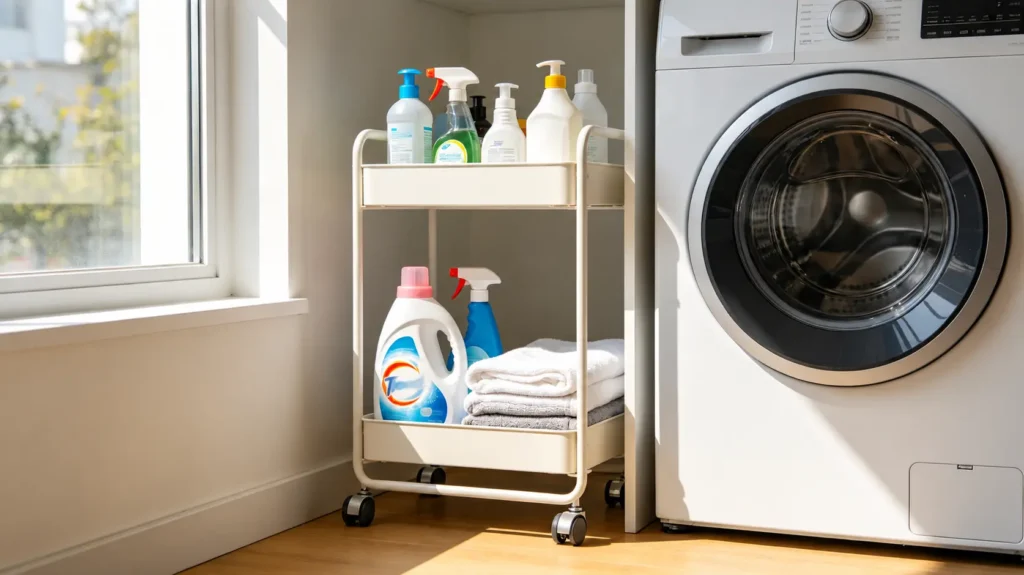
A slim rolling cart can make a tiny gap surprisingly useful, but only if it actually fits, rolls properly, and stays stable when loaded. Before choosing one, I would treat the purchase less like buying a decorative shelf and more like planning a small storage system.
The most common mistake is measuring only the empty parking space. A cart also needs room to enter, roll out, turn, and clear nearby doors, baseboards, rugs, and appliance handles.
Measure the Entire Route
Start by measuring the storage gap, then measure the full route the cart will take. Check the narrowest doorway, hallway corner, threshold, rug edge, and turning point—not just the final location.
Measure the gap at several heights:
- Near the floor.
- Above the baseboard.
- At the cart’s widest shelf or frame.
- Near handles, cabinet trim, and appliance edges.
The narrowest measurement is the one that matters. Baseboards, uneven walls, and appliance sides can make a gap smaller in one spot than it appears from above.
Also include the cart’s full outside dimensions:
- Wheels and caster brackets.
- Pull handles.
- Side hooks.
- Overhanging shelves or lids.
- Any decorative trim.
I like using painter’s tape or a cardboard template to mark the cart’s footprint on the floor. Then I move through the route and check whether the proposed shape clears doors, outlets, rugs, thresholds, and nearby furniture. A cardboard template is especially helpful for a tall pantry cart that needs to be pulled forward before you can turn it.
Leave Clearance
Do not choose a cart that exactly matches the available width. Even if the main frame fits, the wheels or side accessories may scrape the wall or cabinet.
Leave room for:
- Your fingers to grip the handle.
- Baseboards and uneven walls.
- Cabinet and appliance doors.
- Caster rotation.
- Wheel movement over rugs or thresholds.
- Any shelves, hooks, or handles that extend beyond the frame.
As a practical example, a cart advertised as 7.8 inches wide may not be 7.8 inches wide at its widest point. The listed figure may describe the shelf frame while excluding caster projections, handles, or side hooks.
You also need clearance to use the cart. If it sits beside a refrigerator, for example, make sure you can pull it out far enough to reach the rear shelves without blocking the kitchen walkway. For a bathroom cart, check that pulling it forward will not interfere with the door swing or toilet clearance.
Match Tiers to Items
The number of tiers should match the size and shape of what you plan to store.
Choose a three-tier cart when you need room for:
- Taller bottles.
- Small appliances.
- Bulkier cleaning products.
- Larger pantry containers.
- Towels or folded linens.
Choose a six- or seven-tier cart when you mostly need to organize:
- Spices and sauces.
- Toiletries.
- Craft supplies.
- Stationery.
- Small cleaning products.
- Snack packages.
- Personal-care items.
More tiers do not automatically mean more usable capacity. A tall cart may offer excellent organization but leave little vertical clearance on each shelf. If you plan to store products of different heights, look for adjustable shelves or a layout that allows at least one taller compartment.
Open shelves are convenient, but small items can look messy or shift while the cart moves. Add bins or baskets for loose products such as hair accessories, cleaning cloths, craft tools, and small pantry packets.
Load for Stability
Load a rolling cart from the bottom up. Put dense items such as detergent, canned goods, bottled drinks, tools, and small appliances on the bottom shelf. Store everyday products in the middle, and reserve the top shelf for lightweight items.
This is especially important with narrow six- and seven-tier carts. Their tall profile gives them excellent storage density, but loading heavy containers high can make them wobble or feel top-heavy.
I would also avoid overloading any cart or pulling it quickly across a threshold. A wheel lock keeps the cart from rolling, but it does not make an unstable or top-heavy cart impossible to tip.
If children or pets can reach the cart, keep cleaners, sharp tools, hot appliances, and other hazardous items out of reach. Open shelving is convenient, but it also makes stored products more accessible.
Consider Materials and Location
The room should influence the material you choose.
- Choose plastic or coated metal for bathrooms and laundry rooms where moisture and splashes are common.
- Choose steel when you want more rigidity in a kitchen, office, pantry, or utility room.
- Consider bamboo or wood lids for bedrooms, living areas, and home offices where appearance matters.
- Use a waterproof tray or liner beneath liquids on wood or bamboo surfaces.
- Avoid exposing untreated wood to repeated water splashes.
Plastic shelves are easy to wipe down and often work well for toiletries, laundry supplies, and lightweight household items. Steel generally feels more substantial, but open metal shelves can still collect dust, crumbs, or grease in kitchens.
For a living room or home office, a cart with a wood or bamboo top may blend into the room better than an open plastic organizer. The tradeoff is that the finished surface may require more care around drinks and spills.
Check the Wheels
Locking casters are worth prioritizing if the cart needs to stay in place while you reach for products. Look for at least two lockable wheels, and check whether the locks are easy to engage with your foot.
But do not assume wheel locks prevent tipping. They only stop the cart from rolling; they do not correct poor weight distribution, an uneven floor, or a tall frame loaded with heavy items.
Before buying, consider:
- Whether the wheels swivel or move only forward and backward.
- Whether the cart must cross rugs or thresholds.
- Whether the wheels can clear baseboards and cabinet edges.
- Whether the floor is level.
- Whether the wheel material is suitable for hardwood, tile, vinyl, or carpet.
- Whether the cart remains stable when pulled out and turned.
I would test a loaded cart slowly at first, especially across a doorway threshold or thick rug. If it catches, leans, or feels difficult to steer when empty, it will usually become more challenging once filled.
The best slim rolling cart is not necessarily the tallest or narrowest model. It is the one that fits your complete route, gives each item enough shelf space, and remains easy to move without becoming top-heavy.
AFFILIATE DISCLOSURE
As an Amazon Associate I earn from qualifying purchases. This article contains affiliate links.
Read our full disclosure.
Final Verdict
After comparing footprint, shelf layout, materials, mobility, capacity, and everyday usefulness, the SPACEKEEPER Slim 3-Tier Rolling Cart is my best overall pick. It offers the most balanced combination of narrow sizing, accessible storage, rolling mobility, and multi-room versatility. Use it beside a washer, bathroom vanity, refrigerator, cabinet, or desk for toiletries, cleaning supplies, pantry items, and office essentials.
For affordable, sturdy, general-purpose storage, I would choose the smaller IKEA RÅSKOG Utility Cart. Its steel shelves, lockable casters, and compact 11-by-15-by-24-inch footprint make it a practical option for bedrooms, dorm rooms, desks, bathrooms, and other spaces where you have more room than an ultra-slim appliance gap. IKEA lists that smaller version at $29.99, although prices and availability can change.
If your main goal is maximum vertical organization, consider a six- or seven-tier slim cart. These models are useful for separating spices, toiletries, snacks, cleaning products, craft supplies, and other small items in a narrow footprint. Just remember that extra tiers usually mean shallower shelves, greater height, and a stronger need for careful weight distribution.
Before purchasing, verify the current:
- Assembled width, depth, and height.
- Total load capacity and per-shelf weight limit.
- Wheel, handle, hook, and lid dimensions.
- Number of included accessories.
- Current price and availability.
- Shipping details and return policy.
Product listings can change between sizes, colors, sellers, and marketplaces, so do not rely only on the product title or a rounded measurement.
The most important safety and usability rule is simple: keep heavy items low and confirm the cart’s complete outside dimensions before ordering. Measure the wheels, handles, hooks, and pull-out route—not just the empty gap where the cart will sit.